
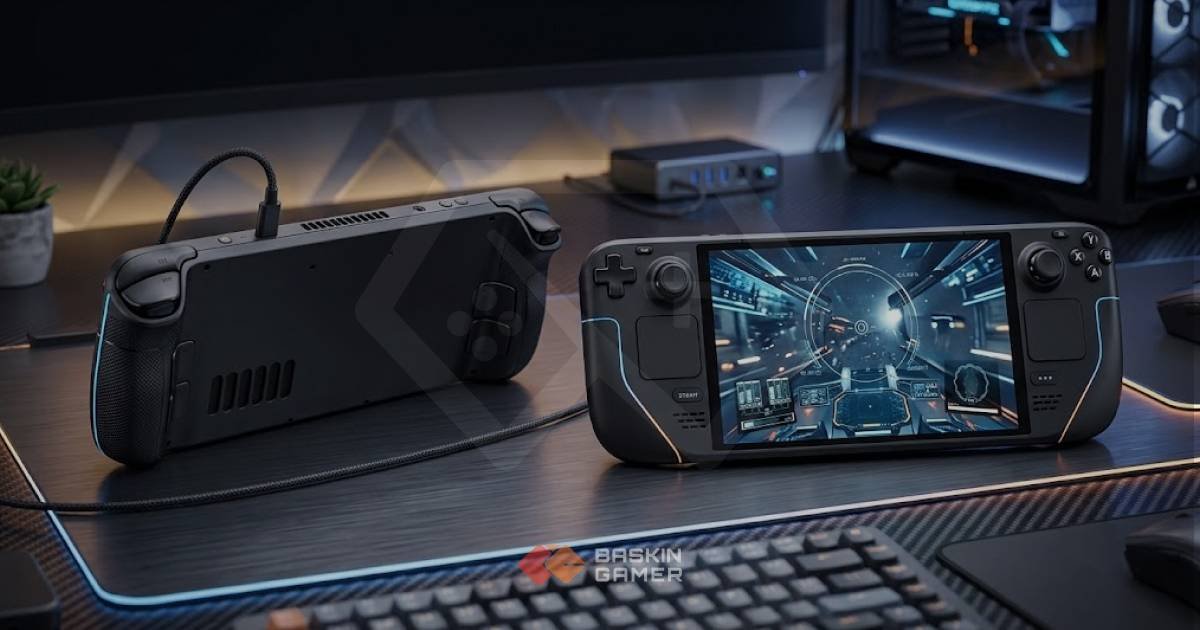
There is no shortage of faster handheld gaming PCs in 2026.
New chips arrive, manufacturers refresh their devices, screens get brighter, batteries change, and another Windows handheld usually isn’t far behind. The market has become comfortable with the idea that a portable gaming PC can be replaced by a newer one every couple of years.
Valve doesn’t seem interested in playing that game.
The company is still working toward a Steam Deck successor, but its latest comments make the basic requirement clear: the next Steam Deck needs to feel like a genuine jump, not simply a newer machine with a faster processor inside it.
That philosophy hasn’t changed even with the current memory supply problems affecting hardware makers.
And that tells us more about Steam Deck 2 than another speculative release date ever could.
Valve Is Still Waiting for the Right Upgrade
Valve engineer Pierre-Loup Griffais recently addressed the state of Steam Deck 2 while discussing the current memory supply situation.
The short version is that the shortage has not fundamentally changed what Valve wants from the next handheld.
Valve is still looking for what Griffais described as a clearly defined performance improvement.
That wording matters.
Valve has been unusually consistent about this since the original Steam Deck launched. The company does not want to increase performance simply because a newer chip is available. A successor has to deliver a substantial improvement while staying within the sort of power and physical constraints that make the Steam Deck useful as a handheld.
In other words, Valve isn’t asking:
“Can we make a faster Steam Deck?”
It is asking:
“Can Steam Deck 2 deliver a major performance boost while keeping the qualities that made the original so successful?”
Those are very different questions.
A Faster Chip Alone Isn’t Enough
The easiest way to imagine Steam Deck 2 is to look at the current machine and replace its APU with something considerably faster.
On paper, that sounds obvious.
In a handheld, it isn’t.
The original Steam Deck was built around a custom AMD APU using Zen 2 CPU cores and RDNA 2 graphics. The system operates within a 4–15W APU power range, while the OLED model kept the same basic performance target despite moving to a more efficient 6nm APU.
A more powerful chip can improve frame rates.
It can also consume more power.
That creates a chain reaction. More power can mean more heat. More heat can mean more cooling. More cooling can affect size, noise and weight. Higher consumption can reduce battery life unless the battery becomes larger. A larger battery adds weight and takes up space.
Suddenly, a “faster Steam Deck” is no longer a simple processor upgrade.
This is why Valve’s performance-per-watt requirement is so important.
The company wants the improvement to happen inside roughly the same handheld equation, rather than solving performance by simply throwing more electricity at the problem.
Valve Also Has Developers to Think About
There is another part of this strategy that is easy to overlook.
Valve has previously explained that keeping a consistent Steam Deck performance target has value for developers. If every generation changes the expected performance level, developers have to consider a moving target when deciding what their games need to run well on the platform.
The current Steam Deck therefore has an advantage beyond its hardware.
Developers know what they are targeting.
That doesn’t mean every game runs perfectly, of course. It means the platform has a relatively stable baseline.
A rushed Steam Deck 2 could complicate that.
If Valve released a modestly faster model simply because the next generation of mobile silicon was available, it could create a product that is faster without feeling meaningfully different to the person holding it.
Valve has already shown that it is willing to avoid that situation.
The Steam Deck OLED is a good example. It brought a substantially improved display, better efficiency and other refinements, but Valve did not turn it into a performance-generation jump. The company kept the same broad performance target instead of fragmenting the platform around a faster model.
The OLED Model Wasn’t Steam Deck 2 — And That Was the Point
The OLED Steam Deck also explains why Valve’s approach can be confusing.
A traditional electronics company might have treated the OLED model as an opportunity to increase performance and market it as a new generation.
Valve didn’t.
The OLED model improved the screen, battery efficiency and several smaller hardware details while keeping the underlying gaming performance close to the original Deck.
That allowed Valve to improve the product without changing the basic promise.
A Steam Deck owner could still expect games to behave around the same performance target.
Steam Deck 2 is different.
Valve has already said that it wants the next version to provide a substantial performance improvement while maintaining a similar power range, weight and battery-life considerations. Earlier comments from Griffais made clear that this was not something the company expected to achieve quickly.
That is the real dividing line between a refresh and a successor.
Memory Problems Aren’t Changing the Core Plan
The current memory market makes Valve’s position even more interesting.
Memory supply has become a significant hardware issue, with shortages and higher component costs affecting new devices. Valve has already acknowledged that those conditions have affected other hardware projects, including the Steam Frame.
Steam Deck 2, however, is being treated differently.
Griffais’ latest comments indicate that the memory situation has not caused Valve to abandon its performance target or redesign the idea around whatever components happen to be easiest to obtain right now.
That doesn’t mean supply conditions have no effect at all.
They could still influence when Valve decides the product makes sense to launch.
But there is a meaningful difference between changing the target and waiting longer to hit it.
Valve appears to prefer the second option.
The Handheld Market Is Moving Faster Than Valve
This is where the company’s strategy becomes more interesting.
The PC handheld market is no longer just Steam Deck and a handful of alternatives. Manufacturers are competing around faster processors, OLED displays, larger batteries, different operating systems and increasingly aggressive hardware configurations.
That creates pressure on Valve.
A Steam Deck owner can look at another handheld and see higher specifications on a product released years after the original Deck.
But Valve isn’t necessarily trying to win a specification sheet.
Its hardware has always been closely tied to SteamOS and the Steam ecosystem. The company has more reason than most manufacturers to think about how long a platform remains coherent.
That helps explain why Valve can tolerate the Steam Deck looking technically old in certain areas.
The company appears more interested in extending the useful life of the platform than turning it into a yearly hardware race.
What Would Actually Make Steam Deck 2 Worth It?
This is probably the most useful question to ask.
Valve hasn’t announced the final specifications, so there is no official checklist for Steam Deck 2.
But its repeated comments give us a reasonable framework.
A meaningful successor would need to deliver a substantial performance increase without pushing power consumption, heat, battery demands or weight into uncomfortable territory.
It would also need to make sense financially.
A handheld can have impressive specifications and still be a poor Steam Deck successor if the improvements force the price too high.
The ideal result would be something more difficult: a machine that can run demanding modern games noticeably better while preserving the qualities that made the original Deck appealing.
Better performance is only one piece.
Better performance at the right power level is the real goal.
Waiting Could Be More Important Than the Chip Name
This is why trying to predict Steam Deck 2 from the latest AMD or Intel announcement is probably missing the point.
Valve needs silicon that fits its requirements.
The company has already discussed watching advances in chip architecture and manufacturing rather than committing to a generation simply because a new processor exists.
A chip can be faster and still be the wrong chip for Steam Deck 2.
It might consume too much power.
It might cost too much.
It might require a larger cooling system.
It might deliver impressive peak performance but not enough improvement at the power levels Valve wants.
Or it might arrive at a time when the surrounding component costs make the final handheld difficult to price.
Those problems don’t disappear because the product is called “Steam Deck 2.”
Valve’s Patience Is Part of the Product Strategy
There is a temptation to view the lack of a Steam Deck 2 as Valve falling behind.
The current handheld market makes that argument easy to understand.
But the company’s own statements point toward a different interpretation.
Valve doesn’t appear to want a new Steam Deck merely because enough time has passed.
It wants a new Steam Deck when the underlying technology can change what the device is capable of without forcing compromises that undermine the handheld experience.
That is a much higher bar.
It also explains why Valve can introduce other hardware while leaving its most successful handheld without a successor.
The Steam Controller, Steam Machine and Steam Frame can follow different hardware cycles. The Steam Deck has a particular problem to solve: it needs a meaningful generational jump while remaining efficient, portable and accessible. Valve has previously described the Steam Deck’s development cycle in much the same way as a console rather than a rapidly refreshed PC.
So When Will Steam Deck 2 Arrive?
There still isn’t a confirmed release date.
And that is probably the most important thing not to invent.
Valve has said enough to establish the direction, but not enough to establish a launch window. Current supply conditions add another variable, and Griffais’ latest comments leave the timing dependent on when the right conditions come together.
For players waiting for a successor, that can be frustrating.
For Valve, it seems intentional.
The company would rather have people wait for a Steam Deck that feels like a genuine next generation than release a device that is technically newer but only modestly better.
That could leave Steam Deck 2 arriving later than some players expect.
It could also mean that, when it finally does arrive, the upgrade feels much more obvious than a routine yearly refresh.
And that may be exactly what Valve wants.
FAQ
Is Valve making a Steam Deck 2?
Yes. Valve has repeatedly confirmed that it is working toward a successor, but there is currently no confirmed release date.
Why hasn’t Valve released Steam Deck 2 yet?
Valve wants a substantial performance improvement without sacrificing power efficiency, battery life, weight and the overall handheld experience. The company has not considered smaller performance increases sufficient for a new generation.
Will Steam Deck 2 be much more powerful?
Valve has not announced specifications. However, its stated goal is a substantial generational performance improvement rather than a modest increase.
Has the memory shortage changed Valve’s Steam Deck 2 plans?
Valve engineer Pierre-Loup Griffais recently said the memory supply situation has not really changed the company’s plans for Steam Deck 2. The larger question is when Valve can deliver the product under the conditions it wants.
Will Steam Deck 2 have better battery life?
Valve has not announced its battery specifications. The company has previously said that a future Steam Deck should deliver more performance without making significant compromises to power efficiency and battery life.
Does Valve have a Steam Deck 2 release date?
No confirmed release date has been announced.
Why doesn’t Valve release a faster Steam Deck every year?
Valve has emphasized the value of maintaining a consistent performance target for developers and players. The company wants a sufficiently large performance improvement before changing that target.
Final Takeaway
Steam Deck 2 is not being held back simply because Valve has forgotten about the handheld.
The opposite appears to be true.
Valve is holding the successor to a higher standard.
The company has already shown that it is comfortable improving the existing Deck without turning every hardware change into a new generation. The OLED model demonstrated that approach clearly. A new screen, better efficiency and refinements were enough to improve the product without moving the platform’s performance target.
Steam Deck 2 needs to cross a different line.
It needs to make demanding games run substantially better while remaining a practical handheld. It needs the right chip, the right power characteristics and a price that makes sense. Until those pieces line up, Valve appears willing to wait.
For a market obsessed with the next model, that is a surprisingly old-school approach.
And it may be the reason Steam Deck 2 takes so long to arrive.
Stay tuned to Baskin Gamer as we bring you the latest updates on game news, releases, and more