
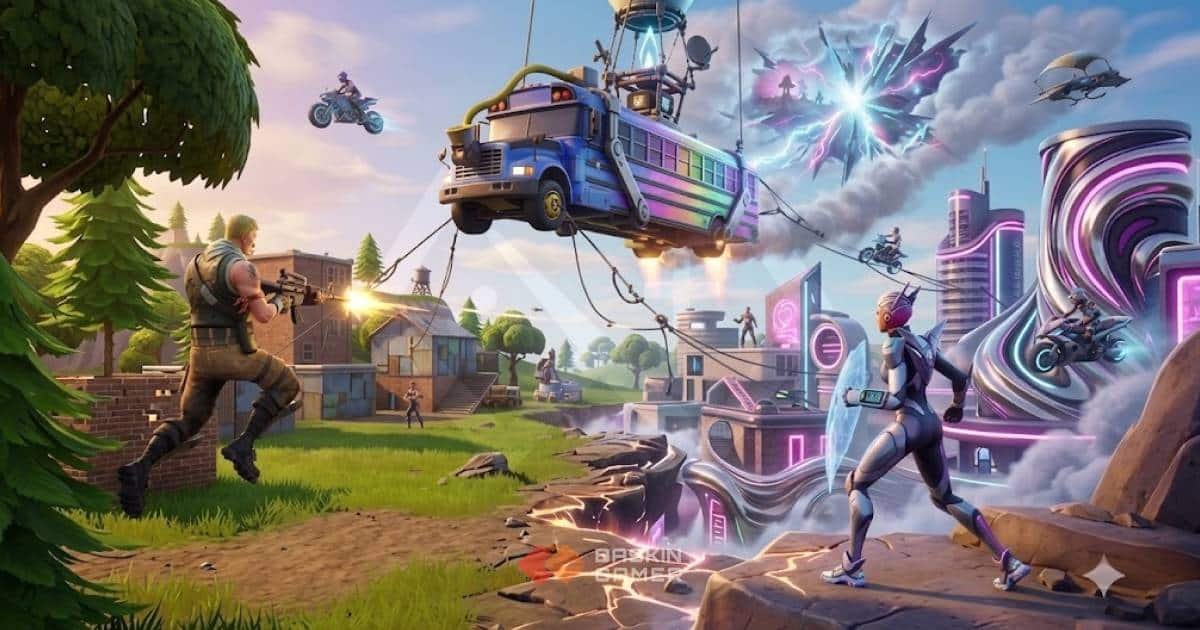
Remember when Fortnite was simply the game where you built a ramp, grabbed a shotgun, and tried to survive until the end?
That version of Fortnite still exists.
It just isn’t the whole story anymore.
Open Fortnite today and the game feels less like a single title and more like a place where several different types of games happen to live together. Battle Royale is still there. So are Reload, Festival, LEGO experiences, creator-made islands, competitive modes, and a constantly changing collection of seasonal ideas.
And Epic keeps pushing further.
That is what makes Fortnite interesting.
It doesn’t seem particularly interested in reaching a point where it can say, “This is Fortnite. Don’t change it.”
Instead, the question appears to be:
What else can Fortnite become?
Quick Summary
- Fortnite has moved far beyond its original Battle Royale identity.
- Current developments show Epic expanding the game into a broader platform for games, creators, music, social experiences, and new technology.
- Chapter 7 Season 3: Runners changed the Battle Royale experience again with the Shattered Coast map, Sprites, new weapons, and extraction mechanics.
- UEFN is becoming increasingly important, with creator-made games, new NPC tools, AI-powered conversations, and stronger discovery systems.
- The bigger strategy is not simply keeping Fortnite popular. It is keeping Fortnite useful as gaming itself changes.
The Biggest Reinvention Happened Without Removing the Original Game
This is where Epic’s strategy gets clever.
Fortnite didn’t abandon Battle Royale when it expanded.
The original experience remained the foundation while new layers were added around it.
That distinction matters.
A player can still drop into a traditional match and get the familiar Fortnite experience. Another player can open Discover and spend the evening playing something that barely resembles Battle Royale.
Both are playing Fortnite.
That flexibility gives Epic room to experiment without forcing every player to follow the same path.
And we’ve seen that approach continue in 2026.
The current Chapter 7 Season 3: Runners introduced the Shattered Coast map, new Sprites, extraction mechanics, weapons, and other changes to the Battle Royale formula.
The interesting part isn’t any single feature.
It’s the willingness to keep changing the formula.
Fortnite’s Map Is Almost a Living Argument
The island is one of Fortnite’s most useful tools.
Epic can change it, destroy it, rebuild it, or turn familiar locations into something players barely recognize.
That creates a strange relationship with the map.
Players become attached to places they know.
Then Epic changes them.
Sometimes people complain.
Sometimes they love the replacement.
Either way, people talk about it.
That’s important for a live game.
A static map eventually becomes background noise. A changing map gives players something to notice.
The latest Shattered Coast is another example. Familiar points of interest were reworked as part of a new island, while Sprites added another layer to how players approach matches.
Fortnite doesn’t just update its map.
It uses the map to reset the conversation.
But Battle Royale Isn’t the Real Long-Term Bet
Here’s where things get more interesting.
The most important Fortnite development might not happen inside a Battle Royale match at all.
It might happen inside UEFN.
Unreal Editor for Fortnite has steadily turned Fortnite into a place where other developers can build their own games. Epic says third-party Fortnite developers have already received more than $900 million through engagement payouts.
That changes the equation.
Epic no longer has to create every experience itself.
Creators can do it.
A player might open Fortnite for Battle Royale today, discover a horror game tomorrow, spend the weekend in a role-playing island, and return later for a completely different experience.
The more good content creators produce, the less Fortnite depends on one particular mode staying popular forever.
That’s a powerful safety net.
Discover Is Becoming More Important Too
Of course, having thousands of experiences means nothing if players can’t find the good ones.
Epic knows that.
In April 2026, it announced major changes to Discover designed to reduce spam and duplicate islands while giving original experiences a better chance of finding an audience. Epic also introduced clearer genre organization and changes intended to improve personalization.
That’s more significant than it might look.
Fortnite is developing a discovery problem similar to the one faced by almost every large content platform.
When there are too many choices, the real challenge isn’t creating more content.
It’s finding the right content.
Epic is now trying to make Discover better at doing exactly that.
And Now Fortnite Is Experimenting With AI
This is probably one of the clearest examples of where Fortnite could be heading.
In July 2026, Epic announced that islands could begin publishing with LLM-powered conversations. Developers can create NPCs and characters that respond through AI-powered dialogue, with 36 Fortnite characters receiving consistent voices and personas for this system.
That sounds like a technical feature.
It could become much more than that.
Imagine a future Fortnite adventure where an NPC doesn’t simply repeat the same three lines every time you interact with them.
You ask a question.
They respond.
You make a different choice.
The conversation changes.
Suddenly, a creator isn’t just designing a map. They’re designing a world that can react.
That’s a very different kind of Fortnite.
Sidekicks Are Another Piece of the Puzzle
Epic has also been giving creators more sophisticated tools for building experiences.
In June 2026, Fortnite Sidekicks became available as scriptable NPCs in UEFN. Creators can customize their appearance, behavior, and animations, opening the door to experiences ranging from creature-collection games to farming adventures and RPGs.
Again, notice the direction.
Epic isn’t simply adding another Fortnite skin.
It’s giving creators another building block.
That distinction is crucial.
A traditional live-service game grows when its developer makes more content.
A platform can grow when more people can make content for it.
Fortnite is increasingly trying to become the second thing.
Fortnite Is Slowly Becoming a Game Platform
This is probably the simplest way to understand the reinvention.
Fortnite started as a game.
Now it increasingly behaves like a platform.
That’s why you can have Battle Royale, LEGO experiences, Festival, Reload, and creator-made islands sitting under the same umbrella.
The player doesn’t necessarily need to leave Fortnite to find something new.
That’s an enormous advantage.
Think about what happens when a player gets bored with one mode.
In a traditional game, they close the game.
In Fortnite, they can open another experience.
That small difference could become incredibly important over the next decade.
Even the Things Fortnite Removes Tell Us Something
Reinvention doesn’t mean keeping everything forever.
Epic has also retired experiences.
Ballistic was removed in April 2026, Festival Battle Stage went offline around the same time, and Rocket Racing is scheduled for removal from Fortnite in October 2026.
At first, that might look like a weakness.
I think it’s actually part of the strategy.
If Fortnite is going to keep changing, some experiments will fail.
Some modes won’t find a large enough audience.
Some ideas will work for a while and then run their course.
A platform that refuses to remove anything eventually becomes cluttered.
Fortnite appears willing to make those decisions.
That’s important for a game that wants to keep evolving for years.
The Creator Economy Gives Fortnite Another Engine
There is another reason this strategy could last.
Money.
Not in the usual “sell another skin” sense.
Epic has built a creator economy around Fortnite, with engagement payouts and additional monetization options for developers. Epic says third-party creators have received more than $900 million through engagement payouts, while its current platform supports in-island transactions as another revenue stream.
That creates an interesting relationship.
Creators want players.
Players want good experiences.
Epic wants both groups to remain inside Fortnite.
If the system works, everyone has a reason to keep improving it.
That is much harder to achieve with a normal game.
Fortnite Is Also Learning From Other Games
Fortnite has never been shy about borrowing ideas.
Not necessarily copying a specific game, but understanding what players enjoy.
Fast competitive matches.
Social spaces.
Racing.
Music.
Survival.
Role-playing.
Horror.
Extraction-style mechanics.
Creator-made shooters.
The boundaries between genres have become increasingly blurry inside Fortnite.
The result is a game that can absorb ideas without completely changing its identity.
That’s probably one of its biggest strengths.
So Why Does Fortnite Keep Reinventing Itself?
Because staying the same would eventually make Fortnite easier to replace.
The gaming industry changes.
Player attention changes.
Platforms change.
Technology changes.
What people expect from an online game changes.
Fortnite has responded by changing with them.
The important part is that Epic doesn’t seem to treat reinvention as simply adding another weapon or changing a map.
It is changing what Fortnite is capable of being.
That is a much bigger ambition.
What Could Fortnite Become in Five Years?
This is where the future gets interesting.
We can already see pieces of the direction.
More creator-made games.
Smarter NPCs.
More advanced UEFN tools.
Better discovery.
More social features.
More ways for developers to build and monetize inside the ecosystem.
And perhaps experiences that don’t feel like Fortnite at all, even though they’re running inside Fortnite.
Epic has even described Fortnite as a place where developers can build and distribute games across PC, mobile, and console, with UEFN providing increasingly powerful Unreal Engine-based creation tools.
If that continues, Fortnite’s future may depend less on whether players love the next Battle Royale season.
The bigger question will be whether players still see Fortnite as a place worth visiting.
The Risk of Reinvention
There is a downside.
Change can become exhausting.
Players can become attached to a particular version of Fortnite. Remove too much, change too quickly, or introduce features that don’t fit, and the same flexibility that keeps the game fresh can start pushing people away.
There’s also the risk of Fortnite becoming too broad.
If everything becomes part of Fortnite, what exactly is Fortnite?
That’s a question Epic will have to keep answering.
The platform needs variety without losing its identity.
That’s probably harder than adding another new mode.
The Real Reason Fortnite Has Lasted
Fortnite’s biggest achievement isn’t that it has survived this long.
It’s that it keeps finding new reasons to matter.
A player who joined for Battle Royale can stay for Creative.
A creator can join because UEFN gives them tools to build.
A fan can return for a new season.
A group of friends can find a completely unexpected game inside Discover.
And the next generation of players may experience Fortnite in a way that today’s players haven’t even imagined.
That’s the real reinvention.
Not changing Fortnite into something else.
Changing Fortnite enough that something else can always happen inside it.
Final Take
Fortnite’s future probably won’t be defined by one giant update.
It will be defined by accumulation.
- One new tool.
- One new creator.
- One new mode.
- One new technology.
One unexpected idea that works.
Then another.
The Battle Royale island will remain important, but it may no longer be the complete definition of Fortnite.
That is why the game keeps reinventing itself.
It isn’t simply trying to stay alive.
It’s trying to make sure that when gaming changes, Fortnite changes with it.
And if Epic gets that balance right, Fortnite may eventually be remembered not just as one of gaming’s biggest live-service games, but as one of the platforms that helped change what a game could become.
FAQ
Why does Fortnite keep changing?
Fortnite operates as a live-service game and increasingly as a broader gaming platform. Regular Battle Royale updates keep the core game fresh, while UEFN and Creative allow creators to introduce completely different experiences.
Is Fortnite becoming more than a Battle Royale game?
Yes. Fortnite now includes multiple first-party experiences and a large creator ecosystem. Epic’s developer platform allows creators to publish games that can be discovered and played inside Fortnite.
What is UEFN?
UEFN, or Unreal Editor for Fortnite, is Epic’s development toolset for creating Fortnite experiences. It brings Unreal Engine tools for areas such as rendering, lighting, animation, and worldbuilding into Fortnite’s creator ecosystem.
Why are creators important to Fortnite’s future?
Creators can produce experiences that Epic’s internal teams could never make alone. That gives Fortnite a much larger pipeline of potential games and experiences while helping keep the platform fresh. Epic says more than $900 million has already been paid to third-party Fortnite developers through engagement payouts.
Is Fortnite still mainly a Battle Royale game?
Battle Royale remains a major part of Fortnite, but the broader ecosystem now includes creator-made games and other experiences. Epic’s own Discover changes specifically aim to help players find experiences across genres such as adventure, horror, role-playing, simulation, sports, and strategy.
Could Fortnite eventually become a gaming platform?
It is already moving in that direction. UEFN, Discover, creator monetization, cross-platform distribution, and increasingly advanced creation tools all point toward Fortnite functioning as more than a single traditional game.
Final Thought
The easiest way to misunderstand Fortnite is to ask what it is right now.
That’s never been the whole story.
The better question is what Epic is building it to become.
Because every time Fortnite looks like it has settled into a formula, something changes.
And that’s probably the reason it keeps showing up in gaming conversations years after the original battle royale explosion.
Fortnite’s biggest feature may not be the island.
It may be the fact that the island never stays the same.
Stay tuned to Baskin Gamer as we bring you the latest updates on game news, releases, and more