
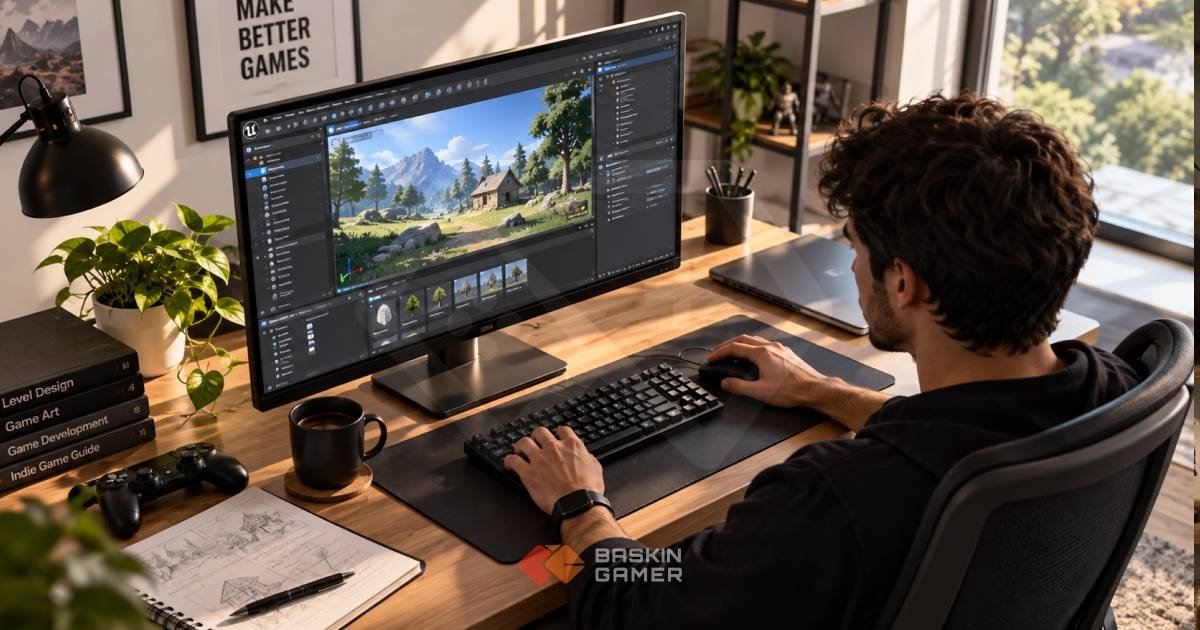
For a long time, having an idea for a game and actually building it were two very different things.
You could have a great concept, understand how the game should feel, and even know exactly what you wanted the player to do. But turning that idea into something playable usually meant learning programming, 3D modeling, animation, level design, audio, testing, and a long list of technical systems that players rarely think about.
That barrier is starting to change.
Game creation tools are becoming easier to use, more visual, and increasingly assisted by artificial intelligence. Roblox is one of the clearest examples of where this shift is heading. Its newer Build tools allow users to create games through prompts, while its broader creator ecosystem is being expanded with AI-assisted development, easier workflows, support for new game formats, and more ways to distribute finished games.
The interesting part isn’t simply that Roblox is adding AI.
It is what the change says about who gets to make games.
Quick Summary
- Game development is becoming more accessible through visual tools, automation, and AI assistance.
- Roblox’s Build tools have already been used to publish approximately 9,000 games, according to Roblox.
- Roblox says 71% of Build creators had never used Roblox Studio before.
- Easier tools can reduce the technical barrier between an idea and a playable prototype.
- That does not mean making a genuinely good game becomes easy.
- As creation becomes easier, design, originality, testing, quality, and discovery become more important.
- Roblox is also expanding beyond its traditional 3D multiplayer model with support for 2D and other game formats.
- The wider lesson applies beyond Roblox: game creation may increasingly become about directing tools rather than building every technical system manually.
The Hardest Part of Making a Game Has Never Been Just Having an Idea
Ideas are cheap in game development.
Execution is where things get complicated.
A developer who wants to make even a relatively small game may have to deal with player movement, combat systems, menus, saving, physics, environments, animation, sound, networking, performance, bugs, and countless small interactions.
A hobbyist can learn these skills. An experienced developer can build them efficiently.
But neither happens overnight.
That has created a familiar gap in gaming: there are millions of people who can imagine a game, but far fewer people who can turn that idea into a functioning product.
The new generation of creation tools is attacking that gap from several directions at once.
Visual editors remove some of the need to write everything manually. Reusable assets reduce the amount of content that has to be created from scratch. Automated testing can catch problems earlier. And AI systems can increasingly translate natural-language instructions into starting points for game mechanics, environments, objects, and other content.
The result is not a world where anyone can instantly create the next major game.
It is something more practical.
The first step is becoming much easier.
Roblox Shows What Happens When the First Step Gets Smaller
Roblox provides a useful case study because the company has spent years building an ecosystem around user-created games.
Its newest Build system pushes that idea further.
Build is designed as a mobile-first creation tool inside the Roblox app. A user can describe the kind of game they want and receive a starting point that can then be changed, tested, shared, or published.
Roblox reported in September that creators had used Build to publish approximately 9,000 games since its alpha launch in New Zealand.
The more revealing number is what happened to the people making those games.
Roblox says 71% of the thousands of users who created a game with Build had never previously used Roblox Studio.
That statistic matters because it points to something bigger than the number of games produced.
A tool has reached people who were not already part of the traditional creation workflow.
The barrier didn’t disappear.
It moved.
Someone who might previously have stopped at the idea stage can now get something playable onto a screen much faster.
AI Is Changing the Relationship Between the Creator and the Tool
Traditional game development often works like this:
A developer decides what needs to happen, learns the technical process required to make it happen, then builds and tests the feature.
AI-assisted development changes part of that relationship.
The creator can increasingly describe an outcome instead of manually handling every step needed to reach it.
That could mean asking for a particular gameplay mechanic, generating a starting environment, creating an object, testing a system, or analyzing game data.
Roblox has already announced AI-powered tools for areas including game creation, plaything, analytics, experimentation, and asset generation. It has also announced a Scene Generator designed to turn a text prompt and reference image into a functional layout that can then be refined in Studio.
But there is an important distinction here.
AI assistance is not the same thing as autonomous game development.
Someone still has to decide whether the generated result is fun.
Someone has to know when the level design feels wrong. Someone has to notice when a mechanic becomes repetitive. Someone has to understand why a game is boring even when all of its systems technically work.
That human layer becomes more important, not less, as the tools become more powerful.
Easier Creation Could Shift the Value Toward Design
Imagine two developers.
One knows how to write a complicated gameplay system but has little understanding of pacing or player motivation.
The other has limited technical experience but understands level design, game feel, progression, and what makes an experience enjoyable.
If creation tools handle more of the technical work, the second developer suddenly has more room to experiment.
This is one of the biggest implications of easier development tools.
They can change which skills become bottlenecks.
Programming will still matter. Technical expertise will not suddenly become irrelevant.
But creators may spend less time solving problems that tools can increasingly automate and more time deciding what should exist in the first place.
That could make game design itself more important.
A creator’s ability to communicate an idea clearly, test it quickly, recognize problems, and improve it may become just as valuable as the ability to build the underlying system manually.
More Games Does Not Automatically Mean Better Games
There is an obvious downside to making game creation easier.
There can be too much of it.
If thousands of people can turn ideas into playable projects quickly, the number of games available to players can grow much faster than the amount of attention available to discover them.
That creates a different problem.
How does a good game get noticed?
Roblox already treats discovery as a major part of its platform. The company says its discovery systems consider engagement and longer-term retention when deciding which experiences receive attention.
That distinction matters.
Making a game is one problem.
Making something people want to keep playing is another.
And getting those players to discover it is a third.
Easier tools may solve the first problem without solving the other two.
In fact, they could make those problems harder by increasing competition.
The Quality Problem Will Become More Important
There is another consequence of lower barriers to creation: quality control becomes more important.
When development requires significant technical knowledge, that requirement naturally limits how many projects can be produced.
When the barrier falls, more experiments can reach players.
Some will be creative.
Some will be rough.
Some will be repetitive.
Some may rely heavily on automatically generated content without having a strong underlying idea.
That does not make accessible tools a bad thing. It simply means the industry has to deal with a much larger supply of content.
Roblox has acknowledged this challenge in its own approach to AI creation. The company says Build-created games still go through safety and review processes, while discovery continues to rely on the same broader systems used for other games.
As creation scales, moderation, safety, discovery, and quality signals become increasingly important parts of the development ecosystem.
Roblox Is Also Making the Definition of a “Roblox Game” Wider
The change is not limited to how games are created.
Roblox is also expanding what its platform can support.
The company has announced tools intended to make 2D and puzzle games easier to build, alongside expanded support for turn-based and asynchronous multiplayer experiences. It is also working toward allowing creators to distribute games as standalone applications across mobile, PC, and consoles.
Web distribution is another major part of that direction.
Roblox says players are expected to be able to launch games directly through Chrome from an Experience Details Page by the end of 2026, without installing an application. Offline solo play is also planned for a later stage, with Roblox targeting mid-2027 availability.
That changes the equation again.
The goal is no longer simply:
“Make a game inside Roblox.”
It is becoming closer to:
“Make a game, then reach players wherever they are.”
That is a much broader ambition.
This Is Bigger Than Roblox
Roblox is a useful example, but it should not be treated as proof that the entire gaming industry is moving in exactly the same direction.
Different engines, studios, platforms, and development teams have very different needs.
A large AAA production still involves enormous teams working across specialized disciplines. A small independent studio may need completely different tools. A hobbyist experimenting with a game after work has another set of requirements altogether.
What is changing across the broader development landscape is the direction of the tools.
They are increasingly trying to remove unnecessary friction.
The same basic idea appears again and again: let creators spend less time fighting the tool and more time working on the game.
Roblox is simply making that philosophy particularly visible because its audience includes people who may never have considered themselves game developers before.
The New Barrier May Be Knowing What to Build
This could be the most interesting part of the shift.
If creating a basic playable prototype becomes dramatically easier, the question changes.
It is no longer only:
“Can you build it?”
It becomes:
“Is it worth building?”
And then:
“Can you make it interesting?”
That is a much harder problem for a tool to solve.
A prompt can produce an environment.
It cannot automatically give a game a memorable identity.
A development assistant can help find a bug.
It cannot decide whether the game’s core loop is worth playing for ten hours.
A generator can create assets.
It cannot guarantee that those assets belong together artistically.
Those decisions still belong to the creator.
In some ways, easier development could therefore make originality more valuable.
When everyone has access to similar tools, the tool itself becomes less of a differentiator.
The idea becomes more important.
The execution becomes more important.
And knowing when to throw away a bad idea may become one of the most valuable skills of all.
What This Could Mean for Independent Developers
For independent developers and hobbyists, the potential upside is significant.
A person who would previously have needed a programmer, artist, technical designer, or several other specialists just to build a prototype may be able to get much further alone.
That does not eliminate the need for specialists.
It can, however, allow a small team to test an idea before committing months or years to it.
That changes the economics of experimentation.
Instead of spending a long time wondering whether an idea works, a creator could potentially build an early version, put it in front of players, learn from the response, and decide what deserves further investment.
The faster that cycle becomes, the more ideas can be tested.
And some of those ideas will inevitably come from people who would never have entered game development under the old barrier.
That is where accessible creation tools could have their biggest long-term impact.
Not by replacing professional developers.
By creating more developers.
The Game Development Bottleneck Is Moving
Game creation is not becoming easy.
It is becoming more accessible.
That distinction matters.
The industry is moving toward tools that can handle more of the technical groundwork, generate starting points, automate repetitive tasks, and let creators communicate with development systems in more natural ways.
Roblox’s Build numbers offer an early glimpse of what that can mean. Approximately 9,000 games created through the early rollout is interesting. The fact that 71% of those creators had not previously used Roblox Studio is arguably more important.
It suggests that lowering the entry barrier can change who participates.
The next challenge is making sure those new creators have enough room to learn, experiment, fail, improve, and eventually build something genuinely worth playing.
Because when everyone can make a game, the rare thing may no longer be the ability to build one.
It may be having something worth playing.
FAQ
Are game development tools becoming easier to use?
Yes. Modern development platforms are increasingly adding visual workflows, reusable systems, automation, and AI-assisted features designed to reduce technical friction.
Does AI mean anyone can make a professional game?
No. AI can assist with parts of development, but game design, testing, creative direction, quality control, and iteration still require meaningful human input.
What is Roblox Build?
Build is Roblox’s mobile-first creation system that allows users to create a starting game experience through prompts and continue developing it through Roblox’s broader creator tools.
How many games have been created with Roblox Build?
Roblox said creators had published approximately 9,000 games through Build during its early rollout.
What does the 71% Roblox Build statistic mean?
Roblox says 71% of the thousands of users who created a game with Build had never previously used Roblox Studio.
Will easier game creation replace professional developers?
There is no evidence that these tools will replace professional game developers as a whole. Their more immediate effect is to reduce some technical barriers and allow creators to work faster or experiment with ideas more easily.
What becomes more important when game creation gets easier?
Design, originality, player experience, testing, quality, and discovery can become more important because creating a playable project becomes less of a barrier while competition for players increases.
Final Thought
The most important change may not be the arrival of AI game creation.
It may be the gradual disappearance of the moment when someone with a game idea has to ask, “But how would I even start building this?”
The easier that first step becomes, the more people can find out whether their idea deserves to become a real game.
Stay tuned to Baskin Gamer as we bring you the latest updates on game news, releases, and more