
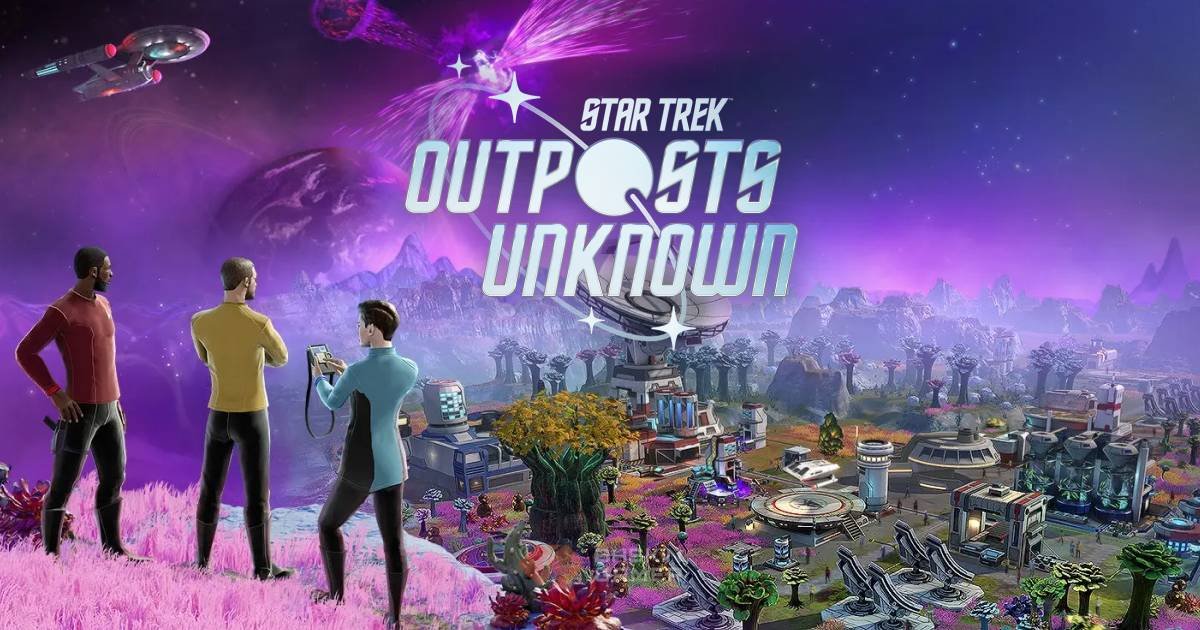
Star Trek has always had its explorers.
Star Trek: Outposts Unknown gives you something very different to worry about: keeping those explorers supplied, productive and alive.
Launching on October 20, 2026, the new strategy simulation puts you in command of the U.S.S. Resonant as you establish research outposts across the X’Lehari System. Exploration is only one part of the job. Resources have to be harvested and processed, infrastructure needs power and water, crew members need support, and the worlds you visit are not exactly welcoming. Steam Store
That makes the opening hours more complicated than simply placing buildings wherever they fit.
You are building an outpost, but you are also building a system that has to keep working.
Here are 10 things worth understanding before you start.
Quick Summary
- Think of your first outpost as a functioning network, not a collection of buildings.
- Research unlocks the technology that lets your operation grow.
- Resources pass through several stages before they become useful.
- Water, power and compute all matter when planning infrastructure.
- Keep an eye on where resources are found and where they need to go.
- Crew management is part of the strategy, not decoration.
- Exploration can expose your outpost to new problems.
- Leave room for logistics instead of filling every available space.
- Do not expand simply because you can.
- Your first hour should be about learning the production loop before chasing ambitious expansion.
1. Learn the Outpost Loop Before You Chase Expansion
The easiest mistake in a colony-building game is thinking that bigger automatically means better.
Outposts Unknown has a more complicated rhythm.
You explore an unfamiliar environment, identify useful materials, harvest them, process what you collect and eventually feed those resources into research and construction. More than 55 resources are part of the game’s wider logistics system, including materials such as Polyalloy, Duranium, Dutronic Chips and Memory Banks.
That creates a chain.
A new building can create another demand. That demand can require another resource. Producing that resource may require power, water, additional processing or transportation.
Before adding another facility, look at what your existing network actually needs.
A stable small outpost is more useful than a large one that constantly runs short of something important.
2. Research Should Shape Your Expansion
Research is not something to leave running quietly in the background while you concentrate on construction.
It is part of your progression.
New technology and building options determine what your outpost can do next, so research should influence your construction decisions rather than simply follow them.
Imagine that you build a large section of your settlement and only afterward discover that the technology you actually need requires a different production chain.
You have created work for yourself.
A better approach is to look ahead before committing large amounts of resources. Ask what the next useful technology gives you and whether your current infrastructure can support it.
Research should answer the question:
“What problem am I solving next?”
3. Treat Resources Like a Network
This is probably the most important thing for beginners to understand.
Resources do not simply appear where you need them.
The game’s logistics system involves harvesting, refining, combining, transporting and finally using materials for scientific and construction work. Buildings also have upkeep requirements, including water, power and compute.
That means a resource shortage is not always caused by a lack of the resource itself.
Maybe production is too slow.
Maybe the material is being processed somewhere else.
Maybe transportation is the bottleneck.
Maybe another building is consuming the supply before it reaches the place you intended.
When something stops working, trace the chain backward instead of immediately building another production facility.
That habit will save you from a lot of unnecessary construction.
4. Leave Space for Infrastructure
A beautiful outpost can become a terrible outpost if you build it without considering logistics.
Water, power and compute require infrastructure, and the pipes and conduits involved take up physical space.
So don’t treat every empty patch of ground as an invitation to build.
Give important areas room to breathe.
Keep production facilities grouped logically where possible. Leave routes between sections. Avoid creating a maze that makes future expansion painful.
Your first layout does not need to be perfect.
It does need to remain understandable.
5. Don’t Build Everything the Moment You Unlock It
Unlocking a new structure creates a temptation: build it.
Resist that instinct.
A building only helps when your outpost has a reason to use it.
Before spending resources, ask three questions:
What does this building produce?
What does it consume?
Do I need its output right now?
If the answer to the third question is no, there may be a better use for your resources.
This is especially important early on, when your production network is still small and every unnecessary construction decision can put pressure on the rest of the system.
6. Pay Attention to Your Crew
Your crew are not simply numbers attached to the outpost.
Outposts Unknown puts you in charge of officers and crew members whose work directly affects how your operation functions. The game includes roles such as Command, Engineering, Medical, Navigation, Science and Security.
Different situations can therefore call for different people.
Engineers can handle maintenance. Medical crew can treat injured personnel. Security personnel can respond to threats.
That makes crew assignment part of your planning.
When bringing new people into the operation, don’t only look at how many extra hands you have.
Think about what your outpost is currently missing.
Adding more personnel also means adding another group of people who need to be supported by your infrastructure.
7. Exploration Is More Than Finding a New Building Spot
The Star Trek name might make exploration sound like the relaxing part.
It isn’t always.
The X’Lehari System contains different worlds and environments, with the developers highlighting planets such as Daegus, Kourou and Neral. Neral is described as the most hostile environment of the three and introduces another level of environmental challenge.
Exploration should therefore have a purpose.
Before sending your crew deeper into unfamiliar territory, make sure the existing outpost can cope with whatever happens next.
You do not want your main operation struggling at the exact moment an expedition discovers something important.
8. Keep Defense in Your Plans
A research station does not become safe simply because you have surrounded it with useful buildings.
The game includes dangerous encounters, and crew members can be placed in roles that respond to threats. Earlier development updates also introduced defensive systems designed to deal with environmental dangers connected to the game’s central mystery.
That gives defense a place in your overall layout.
You do not need to turn the entire settlement into a fortress.
You do need to avoid designing an outpost that has no answer when something goes wrong.
Think of security as insurance.
You hope you don’t need it.
You still want it there.
9. Use Your Ship as Part of the Strategy
Your outpost is not completely isolated.
The U.S.S. Resonant supports operations while settlements are being developed toward self-sufficiency. Interplanetary resource transfers and periodic resupplies are part of the game’s wider logistics system.
That changes how you should think about early expansion.
A new outpost does not necessarily need to solve every problem immediately.
Instead, use the wider network to cover temporary shortages while you develop local production.
Eventually, the goal is to make your outpost increasingly self-sufficient.
Until then, your ship and other resources can act as part of the solution.
10. Make Your First Hour About Learning, Not Winning
Don’t try to build the biggest possible outpost during your first hour.
Build one that teaches you how the game works.
Start with the basics.
Get your essential production running. Watch where resources move. Pay attention to infrastructure. Learn how crew assignments affect the settlement. Open the research options and understand what they unlock next.
Then expand.
The game’s developers have specifically discussed making the logistical side approachable for newcomers while retaining the depth expected from survival and city-builder players. Recent updates have also added clearer information about where resources can be found or produced. Game Hypes
Take advantage of that.
You don’t need to understand the entire technology tree on day one.
You need to understand why the building you just placed is connected to everything around it.
What Should You Do First in Star Trek: Outposts Unknown?
When you land in your first serious outpost, resist the urge to immediately cover the area with structures.
Start by observing.
First, identify nearby resources and understand what your initial production chain requires.
Next, establish the infrastructure needed to keep those facilities operating.
Then, connect your research decisions to the resources you can realistically produce.
Once the basic loop is stable, start looking outward.
Exploration becomes much easier when your home base can continue functioning without constant intervention.
That is also when the game starts to feel less like a building simulator and more like the Star Trek fantasy it is aiming for: you are not simply constructing a settlement.
You are establishing a foothold in an unknown system.
5 Beginner Mistakes to Avoid
Building without thinking about logistics
A building that cannot reliably receive what it needs will not solve your problem.
Expanding before your production is stable
More territory means more things to support.
Ignoring infrastructure space
Water, power and compute networks need room. Your layout should account for them.
Treating every crew member as interchangeable
Different roles exist for a reason. Build your staffing around the problems your outpost actually faces.
Chasing exploration while your base is struggling
Discovery is exciting. A failing supply chain is not.
Fix the second problem before pursuing the first.
The Best Beginner Mindset
Star Trek: Outposts Unknown is not really asking you to build a pretty Starfleet base.
It is asking whether you can make a complicated system work.
Resources have to move.
Research has to unlock useful possibilities.
Crew members need to be assigned intelligently.
Infrastructure has to support production.
Exploration has to happen without leaving the settlement vulnerable.
Once you start seeing those connections, the game becomes much easier to understand.
And that is the trick with a game like this.
Don’t build first and solve the problems later. Build because you already understand the problem you’re trying to solve.
FAQ
What is Star Trek: Outposts Unknown?
Star Trek: Outposts Unknown is a single-player strategy and simulation game focused on building research outposts across unfamiliar worlds, managing resources and crew, researching technology and dealing with threats. Steam Store
When does Star Trek: Outposts Unknown release?
Star Trek: Outposts Unknown is scheduled to launch on October 20, 2026. Steam Store
What is the main gameplay loop?
The core loop revolves around exploring, harvesting resources, processing materials, building infrastructure, researching technology and keeping your crew and outposts functioning.
Why are resources so important?
The game features more than 55 resources that can be researched, harvested, refined, combined and transported before they are used for scientific and construction purposes.
Should beginners expand quickly?
No. Early expansion is easier when your existing production and infrastructure are stable. Expanding too quickly can create additional logistical problems.
Does crew management matter?
Yes. Crew members have different roles, and their assignments can affect maintenance, medical support, security and other parts of your operation.
What should beginners focus on first?
Learn the basic resource and infrastructure loop before attempting ambitious expansion. Once you understand how production, research, crew and logistics interact, larger outposts become much easier to manage.
Stay tuned to Baskin Gamer as we bring you the latest updates on game news, releases, and more