
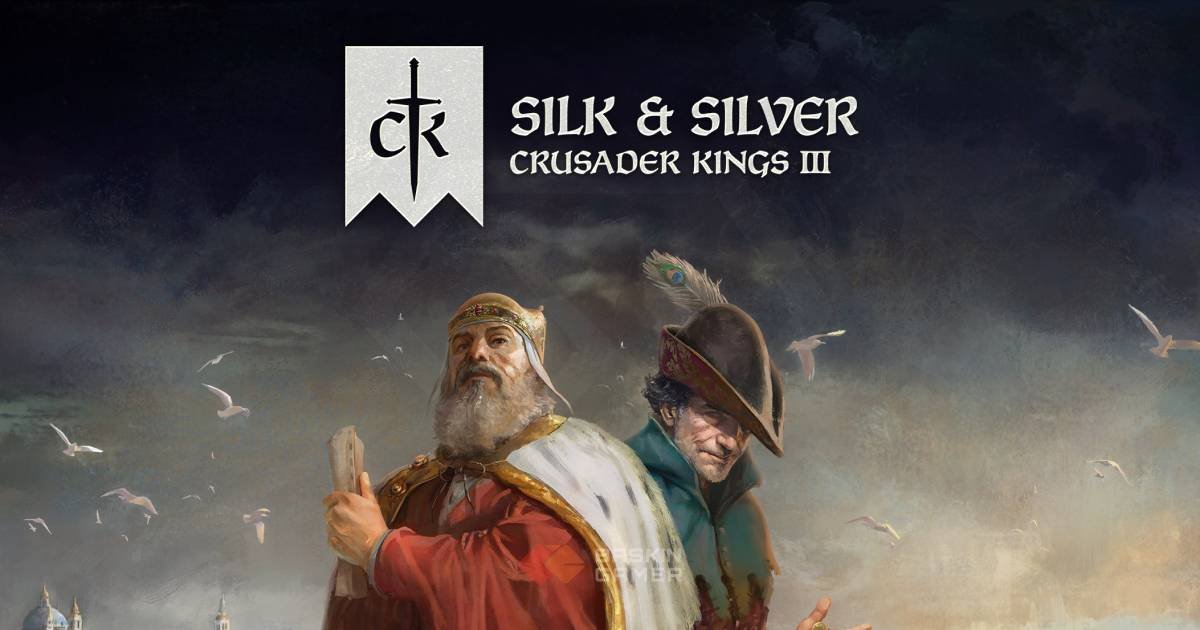
In Crusader Kings III, a powerful dynasty usually begins with land, a title or a claim to somebody else’s throne.
Silk & Silver offers another route.
You can build influence through a merchant company, turn profitable trade into political leverage, lend money to rulers or compete against established families for control of a republic. Instead of inheriting a kingdom and trying to keep it together, you can begin without a landed realm and work your way into the medieval world’s centres of power.
Released on November 17, 2026, Crusader Kings III: Silk & Silver introduces Merchant and Republic governments, an expanded trading system and two new historical bookmarks. It also arrives alongside the free 1.21 Florin update, which changes the wider economic systems of the base game.
For returning players, the biggest adjustment is understanding that wealth is no longer just something that supports your political ambitions. It can become the foundation of those ambitions.
Here’s how to approach the new systems before starting your first merchant campaign.
Quick Summary
- Release: November 17, 2026.
- Developer and publisher: Paradox Interactive.
- Platforms: PC.
- Base game required: Yes, Crusader Kings III is required.
- New governments: Merchant and Republic.
- Merchant specializations: Caravaneer, Creditor and Artisan.
- Trade goods: More than 40.
- New bookmarks: 1066 – Channels of Commerce and 1178 – Guelphs & Ghibellines.
- Major systems: Trade routes, merchant mansions, monopolies, Trade Posts, Trade Leagues, laws and Assemblies.
- Free update: Version 1.21 Florin introduces broader economic changes for all players.
1. What Is Crusader Kings III: Silk & Silver?
Silk & Silver is a major expansion for Crusader Kings III that puts medieval commerce and republican politics at the centre of the experience.
The expansion introduces two playable government types.
Merchant government allows you to lead a landless merchant family operating a trading company. You develop commercial connections, build wealth and use relationships with powerful rulers to expand your business.
Republic government puts you in control of a patrician family competing against other influential houses. Elections, political popularity, laws and control over trade all become important parts of your campaign.
These are not simply alternative ways to collect gold. They introduce different political relationships and objectives.
One important requirement: Silk & Silver is DLC, not a standalone game. You need the base game, Crusader Kings III, to play it.
2. Understanding Merchant Government
Merchant government is the more unusual addition for players accustomed to traditional CK3 campaigns.
Instead of beginning as a landed ruler, you lead a merchant family operating from a company domicile. Your objective is to grow that business and turn its commercial influence into something much more powerful.
Trade routes connect markets and create opportunities to move goods. The expansion includes more than 40 trade goods, giving merchant companies different commercial opportunities to pursue.
As your company develops, you can gain experience in traded goods and improve your business expertise. That progression helps shape the identity and reputation of your enterprise.
Political relationships matter too.
A successful merchant cannot operate entirely outside the world of kings, nobles and other powerful families. You can use money and intrigue to influence rulers, secure patrons and strengthen your company’s position.
The Merchant Mansion
Your company needs a home, and the merchant mansion serves as its central base of operations.
You can spend gold and prestige to improve its grounds. Developing the mansion also supports the expansion of your business, including access to additional trade routes.
Think of it as more than a decorative headquarters.
Its development is connected to the growth of your company, giving you another reason to consider how you use the resources you accumulate.
Trade Monopolies
Competition is an important part of the new merchant experience.
You can use political influence to obtain exclusive rights to trade particular goods in markets. Push that control further and you can establish a complete monopoly.
This introduces another layer of interaction between commerce and politics.
Your rivals are not necessarily defeated through armies. Commercial competition, influence and access to markets can become equally important ways to weaken their position.
3. The Three Merchant Specializations
One of the first major decisions in a merchant campaign is choosing your specialization.
The expansion introduces three paths, each built around a different commercial activity.
Caravaneer
Focus: Moving goods and expanding trade
Caravaneers concentrate on transporting goods through trade routes and growing their commercial networks.
This is the specialization most closely associated with the movement of merchandise across the medieval world.
If the idea of building a business around trade connections appeals to you, this is the natural path to investigate first.
Creditor
Focus: Lending money to rulers
Creditors use financial relationships to develop influence.
Instead of concentrating primarily on moving merchandise, you can lend money to rulers and build relationships through financial agreements.
This creates an interesting connection between wealth and political power. A ruler might possess land and military strength, but financial support can still become an important relationship.
Artisan
Focus: Creating artifacts
Artisans build their business around craftsmanship and the production of new artifacts.
Rather than making trade volume or lending the centre of your strategy, this specialization gives you a different commercial identity.
It is worth exploring if you prefer the idea of developing a business through crafted goods.
Which specialization is best?
There is no verified universal ranking that makes one path the strongest choice for every campaign. Each offers different content and bonuses.
For a first playthrough, choose based on the kind of merchant story you want to create rather than assuming one specialization guarantees faster progression.
4. How the New Trade System Works
Trade is the foundation of the expansion.
More than 40 goods are included, with opportunities to establish routes and grow your company’s reach across different markets.
However, the system is not simply about collecting merchandise and watching gold accumulate.
Your commercial development involves several connected elements:
- Trade routes: Establish connections that allow your company to move goods.
- Trade expertise: Gain experience with traded goods and develop your business capabilities.
- Markets: Compete for access and influence over particular goods.
- Monopolies: Use political leverage to secure exclusive trading rights.
- Merchant reputation: Develop your company’s standing as its operations expand.
- Political patrons: Build relationships with powerful characters who can support your commercial ambitions.
A useful starting habit is to understand what your company is trying to accomplish before expanding in several directions.
A growing network creates opportunities, but it also introduces competition. Keep an eye on your commercial position and the relationships surrounding your business.
5. Understanding Republic Government
Merchant companies are only half of the expansion.
Republic government introduces a different political experience built around patrician families, competing interests and the position of the Doge.
In a republic, wealth and popularity influence who holds power. Your family competes with rival houses through political manoeuvring, laws, bribery and support within the Assembly.
The Doge is the leading figure in the republic, but holding that position is not simply a matter of inheriting a title.
You need to maintain influence and secure enough political support to remain relevant.
Laws and Assemblies
Republics have their own constitutional arrangements.
Through laws and Assemblies, you can influence how the government operates, including leadership terms and the use of the state treasury.
That makes political management an important part of the campaign.
You are not just trying to become wealthy. You are trying to shape the institution through which that wealth becomes power.
Choosing Your Republic’s Administration
The expansion allows you to choose an administration that influences the direction of your republic.
Paradox describes three broad possibilities:
- A seafaring commercial power.
- An expansionist house of nobles.
- A city-state shaped by the will of ordinary citizens.
These options give your republic a different political identity. Consider what kind of state you want to build before deciding how to approach its development.
Trade Posts and Trade Leagues
Republics can establish Trade Posts in foreign counties, extending their commercial influence beyond their immediate territory.
You can also form Trade Leagues with other republics.
These agreements provide commercial and military benefits, making them relevant to more than just trade income.
For a republic surrounded by competing political interests, relationships with other trading powers can become an important part of its long-term position.
6. Which Bookmark Should You Choose?
Silk & Silver introduces two new starting bookmarks.
| Bookmark | Setting | What makes it interesting |
|---|---|---|
| 1066 – Channels of Commerce | Medieval trading networks | Merchant families, trade routes and commercial expansion |
| 1178 – Guelphs & Ghibellines | Northern Italy | Political conflict between supporters of papal and imperial ambitions |
1066 – Channels of Commerce
This is the natural starting point if you want to explore the merchant side of the expansion.
The bookmark features prominent merchants operating in a world where spices, silk and silver create opportunities for commercial growth.
It is particularly relevant if your goal is to understand the new trading systems before moving into more complicated political campaigns.
1178 – Guelphs & Ghibellines
This bookmark takes you into a different kind of political environment.
Northern Italy is caught between competing papal and imperial ambitions, with the Guelphs and Ghibellines representing opposing political factions.
If you are more interested in republican politics and the struggle for influence, this is an appealing historical setting.
The two bookmarks offer different entry points into the expansion. Your choice should depend on whether you want to begin with commercial development or political conflict.
7. Beginner Tips Before Starting Your First Campaign
There is a lot to learn, particularly if you’ve spent most of your time playing traditional kings and emperors.
These suggestions are starting priorities rather than tested optimal strategies.
1. Understand which government you are playing
Merchant and Republic governments have different responsibilities. Learn the distinction before applying strategies from one to the other.
2. Pick a specialization with a clear purpose
Caravaneer, Creditor and Artisan support different commercial approaches. Choose one and explore its systems before attempting to understand everything simultaneously.
3. Pay attention to trade routes
Commercial connections are central to merchant progression. Understand how your routes contribute to the company’s development.
4. Don’t ignore political relationships
Wealth alone is not the entire system. Patrons, rulers and rival families all matter when trying to expand your influence.
5. Develop your merchant mansion
Your domicile is connected to your company’s growth. Understand which improvements support the direction you want to pursue.
6. Learn how monopolies work
Exclusive market rights can become an important source of commercial influence. Pay attention to competition rather than assuming every market will remain available.
7. Understand your republic’s politics
If you choose Republic government, learn how the Assembly, laws and Doge position interact before committing to a political strategy.
8. What Does the Free 1.21 Florin Update Add?
There is an important difference between the expansion and the update released alongside it.
The 1.21 Florin update is free for all Crusader Kings III players. You do not need to own Silk & Silver to receive its broader economic changes.
The update introduces:
- Trade goods.
- Building needs.
- Roads.
- A wider economic overhaul.
- A new building system.
- Additional changes to the base game.
This matters because the economic changes are not exclusive to merchant campaigns.
Even if you don’t purchase the expansion, the free update changes parts of the wider CK3 experience.
For returning players, it is worth understanding which systems come from the update and which require Silk & Silver. The new Merchant and Republic governments, their associated features and the two expansion bookmarks belong to the DLC.
Final Thoughts
Silk & Silver gives Crusader Kings III a different way to tell its stories.
A campaign no longer has to begin with a ruler trying to expand a kingdom. You can build a merchant company, develop commercial influence, finance powerful rulers or compete for control of a republic.
That changes the relationship between wealth and political authority.
For newcomers to the expansion, the 1066 bookmark is a sensible place to begin exploring merchant gameplay. Learn the trade system, understand your specialization and gradually develop the political connections that support your company.
Once those systems make sense, the republic experience offers another way to turn commercial power into political control.
In medieval politics, a crown is valuable. But sometimes the person financing the kingdom has more influence than the person wearing it.
FAQ
What is Crusader Kings III: Silk & Silver?
It is a major CK3 expansion introducing Merchant and Republic governments, expanded trade systems, merchant specializations and two new historical bookmarks.
Does Silk & Silver require Crusader Kings III?
Yes. The expansion requires the base game, Crusader Kings III.
What are the three merchant specializations?
Caravaneer focuses on moving goods, Creditor focuses on lending money to rulers, and Artisan focuses on creating artifacts.
How many trade goods are in Silk & Silver?
The expansion features more than 40 trade goods.
What is Republic government in CK3 Silk & Silver?
It allows players to lead a patrician family in a republic, compete for the Doge position and influence government through laws, Assemblies and political relationships.
What are the new Silk & Silver bookmarks?
The expansion introduces 1066 – Channels of Commerce and 1178 – Guelphs & Ghibellines.
What is the 1.21 Florin update?
It is a free update released alongside Silk & Silver. It introduces broader economic changes, including trade goods, building needs, roads and a new building system.
Can you play Silk & Silver without owning the DLC?
You can receive the free 1.21 Florin update without owning the expansion, but the new Merchant and Republic governments and their expansion content require Silk & Silver.
Stay tuned to Baskin Gamer as we bring you the latest updates on game news, releases, and more