
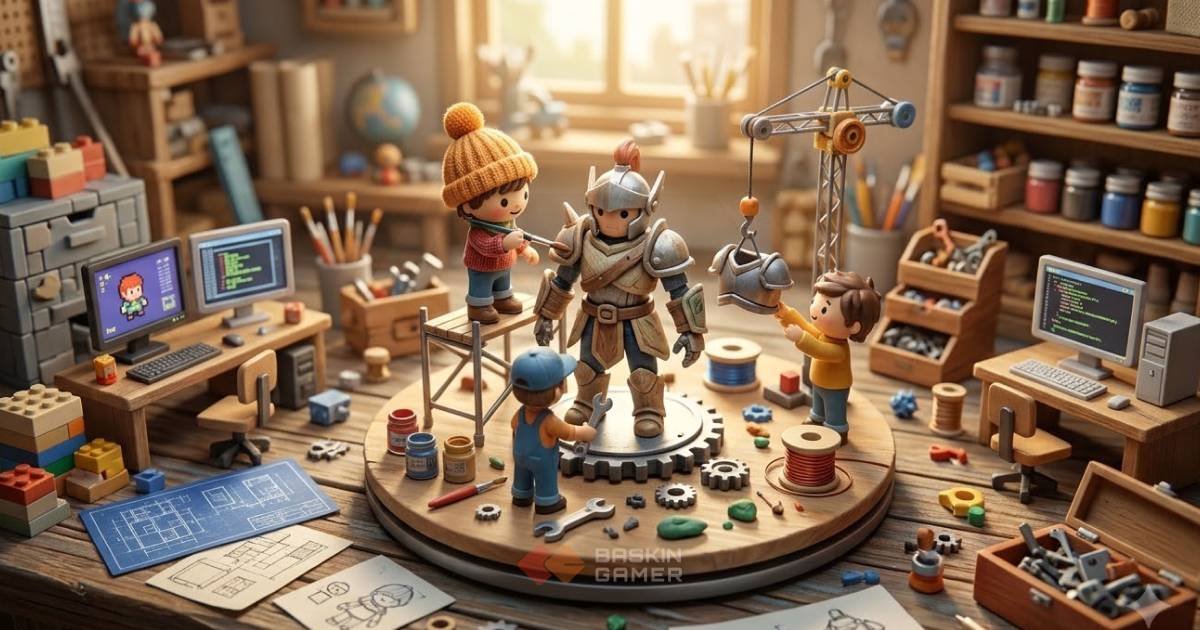
A game may carry one studio’s name, but that doesn’t mean a single team built every part of it.
Behind a major release, several development teams may be working on different parts of the same production. One studio might handle the core gameplay, another could create character animations, while external specialists contribute engineering, quality assurance or console porting.
This production model is known as game co-development, and it is becoming an increasingly important part of the industry.
The November 2026 GDC State of the Game Industry report offers a clear indication of its reach. According to the survey, 45% of studio workers said their companies had hired co-development services for their most recent projects.
That figure reflects a shift in how studios approach production. Instead of relying entirely on permanent internal teams, developers increasingly work with external partners who bring specialist skills, additional capacity and production experience.
But bringing another studio into a project is not as simple as assigning tasks and waiting for finished files. External teams must understand the game’s direction, follow its technical requirements and work within the same production pipeline.
Here’s why game studios rely on co-development partners, what those partnerships actually involve and why managing them has become an important part of modern game production.
Quick Summary
- 45% of studio workers surveyed for GDC’s November 2026 report said their companies hired co-development services for their most recent projects.
- Co-development brings external development teams into a game’s production process.
- Common contributions include art, animation, engineering, porting, quality assurance and localisation.
- Unlike task-based outsourcing, co-development can involve ongoing collaboration and shared production responsibilities.
- External partners help studios access specialist skills and expand production capacity without building every capability internally.
- The 2026 XDS Insights Report identifies communication as the leading challenge in external-development partnerships.
- 42% of developers surveyed by XDS said their providers subcontract portions of work to third parties.
1. What Is Game Co-Development?
Game co-development is a production arrangement in which an external development studio works alongside a game’s primary developer.
Rather than operating as a completely separate supplier, the external team becomes part of the wider development process. It may work on specific features, technical systems, art assets or other production responsibilities while coordinating with the main studio.
The level of involvement depends on the project.
One partner might contribute a dedicated engineering team to help develop gameplay systems. Another could take responsibility for environment art, character animation or a particular section of production.
In larger arrangements, multiple external teams may work across different disciplines while the primary studio maintains responsibility for the overall creative direction and project coordination.
The important distinction is that co-development is built around collaboration. Both sides need to understand how their work connects to the final game.
2. Co-Development vs Traditional Outsourcing
The terms outsourcing and co-development are sometimes used interchangeably, but they can describe different working relationships.
Traditional outsourcing often involves assigning a defined task or deliverable to an external provider. The studio explains what it needs, agrees on the requirements and receives the completed work.
Co-development usually involves deeper integration into the production pipeline.
Consider a studio creating a large open-world game.
It might outsource a collection of environment assets with clearly defined specifications. The external provider creates those assets and delivers them for review.
A co-development partner could instead work alongside the internal environment team throughout production. It may participate in planning, follow the same asset pipeline, respond to changing requirements and coordinate its work with level designers and technical artists.
The difference is not necessarily the type of work being produced. It is the relationship between the teams, their responsibilities and how closely they collaborate.
| Traditional outsourcing | Co-development |
|---|---|
| Often focused on defined deliverables | Often involves ongoing production responsibilities |
| External provider works to an agreed brief | External team integrates with the development pipeline |
| Communication may centre on delivery and revisions | Communication continues throughout production |
| Scope is often task-specific | Scope can cover features, systems or entire disciplines |
| Primary studio manages integration | Both teams coordinate their contributions |
These models can overlap. A studio may use traditional outsourcing for certain assets while maintaining a deeper co-development partnership for engineering or gameplay work.
3. Why Game Studios Bring in External Teams
Game production involves several specialised disciplines. Even experienced studios may not have every capability available internally.
External partners provide access to those skills when a project requires them.
Specialist Art and Animation
Art production is one of the areas where external development can make a significant contribution.
Games may require large quantities of character models, environments, props, textures, visual effects and animation. Producing all of these assets internally can place considerable demands on an art department.
External teams can support specific parts of the visual production pipeline.
For example, a partner might create environment assets, produce character animations, handle technical art tasks or contribute to cinematic sequences.
The primary studio can then focus its internal resources on visual direction, gameplay requirements and final integration.
Engineering and Technical Expertise
Some development challenges require knowledge that a studio may not need throughout the entire project.
External engineering specialists can contribute to gameplay systems, performance optimisation, tools development, technical integration and other programming responsibilities.
This can be particularly useful when a project introduces unfamiliar technology or requires additional engineering capacity during a demanding production stage.
The benefit is not simply having more programmers. It is gaining access to people with experience in a particular technical area.
Console and PC Porting
Bringing a game to another platform involves more than changing its build settings.
A console version may require platform-specific integration, performance adjustments, control support, certification preparation and extensive testing.
Porting partners can help studios manage this work while the primary development team continues focusing on the core game.
The same principle applies when adapting a game across different PC configurations and hardware environments.
Quality Assurance and Localisation
Quality assurance is another important part of external development.
Testing a modern game involves checking gameplay systems, identifying bugs, verifying updates and examining how different hardware configurations affect performance.
External QA teams can provide additional testing capacity and specialised coverage during different production stages.
Localisation partners contribute in another way. They help prepare text, dialogue and other language-dependent elements for international audiences.
Both disciplines require coordination with the primary studio because errors in testing or localisation can affect the final player experience.
Additional Production Capacity
Sometimes a studio already has the necessary expertise but simply doesn’t have enough people available.
A production milestone might require more environment artists, animators, engineers or testers than the internal team can provide at that moment.
Co-development partners help expand the available workforce without requiring the studio to recruit every specialist permanently.
This additional capacity can be especially valuable when production requirements change between development stages.
4. How External Teams Fit Into a Game’s Production Pipeline
Adding an external development partner requires more than sharing project files.
The teams need a common understanding of the game’s requirements, technical standards and production schedule.
A typical collaboration can involve several connected stages.
- Project planning: The primary studio identifies the work that needs external support and defines the partner’s responsibilities.
- Technical onboarding: External developers receive the necessary documentation, tools, access permissions and workflow guidance.
- Production integration: Both teams agree on how tasks, assets, code and progress updates will move through the production pipeline.
- Review and feedback: Deliverables are checked against technical and creative requirements. Revisions are communicated and tracked.
- Integration and testing: Completed work is incorporated into the main project and tested alongside other systems.
- Final delivery: Both teams verify that their responsibilities have been completed and that outstanding issues are addressed.
The process can vary considerably depending on the partnership.
A team working on environment assets may follow a different workflow from an engineering partner contributing to core gameplay systems. However, both need clear requirements and a reliable way to coordinate their work.
5. Benefits for Large Studios and Independent Developers
Co-development is not limited to major publishers or large development companies. Different types of studios can use external partnerships to solve different production problems.
Why Large Studios Use Co-Development
Large studios often manage complex projects involving multiple disciplines and long production schedules.
External partners can help them expand specific departments, access specialist expertise and distribute workloads across teams.
A large studio might already have an established internal engineering department but need additional animation capacity for a particular production phase.
Instead of expanding every department permanently, it can bring in an external partner with the relevant experience.
This also allows internal teams to concentrate on the areas that require their closest attention.
Why Independent Studios Use External Partners
Smaller studios face a different set of challenges.
An independent developer may have a strong creative team but lack dedicated specialists for porting, localisation, technical art or extensive quality assurance.
Co-development can give these studios access to additional capabilities without requiring them to establish every department themselves.
However, external support still requires planning. A smaller team must understand which responsibilities it can manage internally and which ones need specialist assistance.
The goal is not to hand over the entire production. It is to fill specific gaps while maintaining control over the game’s direction.
6. The Risks of Working With Multiple Development Partners
External development can increase production capacity, but it also introduces coordination challenges.
The 2026 XDS Insights Report highlights this problem. Communication became the leading challenge in external-development partnerships, overtaking delivery and security concerns.
That finding is important because it shows that technical capability alone does not guarantee a successful partnership.
Communication and Coordination
Different teams may operate in different time zones, use different internal processes or interpret project requirements differently.
A small misunderstanding can affect several connected tasks.
For example, an environment asset might meet its original specifications but no longer match a level designer’s updated requirements. If that change does not reach the external team in time, additional revisions become necessary.
Clear documentation, regular communication and defined approval processes help reduce these problems.
Maintaining Creative Consistency
A game needs a consistent visual identity and gameplay experience.
When several teams contribute assets or features, the primary studio must ensure that everything follows the same creative direction.
This involves shared art guidelines, technical standards, review procedures and clear ownership of important decisions.
Without those controls, individual contributions may work in isolation but fail to feel like parts of the same game.
Security and Access Management
External developers often need access to project files, internal tools, documentation and development environments.
Studios must decide what information partners can access and how sensitive material should be protected.
Access permissions, secure file sharing, confidentiality agreements and internal security procedures all become important.
Accountability and Subcontracting
Another challenge appears when external providers involve additional companies in their work.
The 2026 XDS Insights Report found that 42% of developers said their providers subcontract portions of work to third parties.
This adds another layer to the production relationship.
The primary studio may be working directly with one partner while some responsibilities are handled by another organisation. Without clear visibility, it can become harder to understand who is performing the work, how information is being handled and who is responsible for resolving problems.
Contracts and production agreements should establish whether subcontracting is permitted and what oversight is required.
7. Managing External Partners Is Now a Production Skill
The growth of co-development means studios need more than talented developers. They also need people who can coordinate work across organisational boundaries.
Producers, project managers, technical leads and discipline heads play an important role in making these partnerships effective.
They need to understand how internal and external teams depend on one another, identify production risks and ensure that important decisions reach the right people.
A successful partnership requires several things:
- Clear ownership of responsibilities.
- Consistent technical and creative documentation.
- Agreed delivery schedules and milestones.
- Reliable communication channels.
- Defined review and approval procedures.
- Appropriate security and access controls.
- Visibility into subcontracted work.
- A clear process for handling changes and production problems.
These are not administrative details that can be handled after development begins. They influence how effectively the teams work together throughout production.
8. What Co-Development Means for the Future of Game Development
The November 2026 GDC report and the 2026 XDS Insights Report point towards an industry where external development has become a significant part of production planning.
The 45% figure from GDC shows how widely studios are using co-development services. Meanwhile, XDS highlights the growing importance of communication and oversight as partnerships become more complex.
This does not mean every studio will rely on external teams for every project.
Some developers will continue producing games primarily with internal teams. Others will build long-term relationships with specialist providers, while smaller studios may use external support for selected technical or production requirements.
The balance will depend on the project’s scale, skills required, internal resources and production strategy.
What is becoming increasingly clear is that game development is not always confined to the organisation whose name appears on the finished product.
The ability to work effectively across multiple studios is becoming another important part of building modern games.
Final Thoughts
Game co-development is changing how studios organise production.
External partners can contribute specialist skills, additional capacity and technical experience that would otherwise be difficult to maintain entirely in-house. For large studios, they can support complex production pipelines. For independent developers, they can provide access to capabilities beyond the core team.
But collaboration introduces responsibilities of its own.
Communication, creative consistency, security and accountability all need attention, particularly when several organisations contribute to the same project.
The real value of co-development does not come from simply adding more developers. It comes from bringing the right teams together, giving them a clear understanding of the project and making sure their work fits into one coherent production process.
As games continue to involve increasingly specialised development pipelines, managing those partnerships may become just as important as managing the teams working inside the primary studio.
FAQ
What is game co-development?
Game co-development is a production arrangement in which an external development studio works alongside a game’s primary developer, contributing skills, resources or production responsibilities.
What is the difference between co-development and outsourcing?
Traditional outsourcing often focuses on delivering specific tasks or assets. Co-development generally involves closer integration with the primary studio’s production pipeline and ongoing collaboration between teams.
What services do game co-development studios provide?
Common services include art production, animation, engineering, technical development, console and PC porting, quality assurance, localisation and other specialised development work.
Why do game studios use co-development partners?
Studios use external partners to access specialist expertise, expand production capacity and support development requirements without building every capability internally.
How common is co-development in the gaming industry?
In GDC’s November 2026 State of the Game Industry report, 45% of studio workers said their companies had hired co-development services for their most recent projects.
What are the biggest challenges of game co-development?
Communication, creative consistency, security, accountability and coordination are major challenges. The 2026 XDS Insights Report identified communication as the leading challenge in external-development partnerships.
Do independent game studios use co-development?
Yes. Independent developers can work with external specialists for services such as porting, engineering, animation, quality assurance and localisation when those capabilities are not available internally.
Can co-development partners subcontract work?
Some providers do. The 2026 XDS Insights Report found that 42% of developers said their providers subcontract portions of work to third parties. Studios need clear agreements and oversight when this happens.
Stay tuned to Baskin Gamer as we bring you the latest updates on game news, releases, and more