
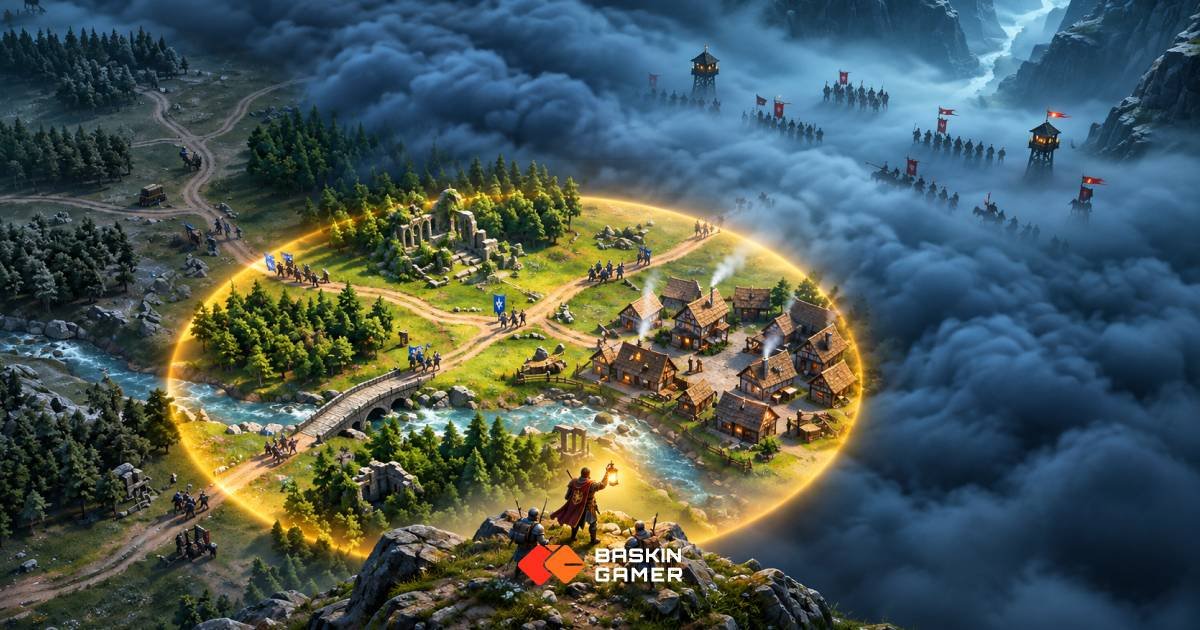
A player moves a scout across an unfamiliar map. A section of the world becomes visible, revealing a river, a settlement and perhaps an enemy position. The surrounding territory remains hidden. The player now has more information than before, but still cannot be certain what lies beyond the newly explored area.
This is the basic experience behind fog of war in video games. It looks like a darkened section of a map, but its purpose goes much deeper. Fog of war controls the information available to players, turning exploration, scouting and uncertainty into important parts of gameplay.
Strategy games use it to make territory discovery meaningful. Competitive multiplayer games can take the idea further by controlling which information reaches a player’s device. Riot Games has demonstrated both sides through its work on League of Legends and VALORANT.
Understanding these systems reveals an important part of game design: hiding information can be just as important as showing it.
Quick Summary
- Fog of war controls what information players can access during a match.
- Strategy games commonly distinguish between hidden, previously explored and currently visible areas.
- Units, buildings and abilities can reveal territory through vision ranges and line-of-sight checks.
- Terrain height and obstacles can prevent units from seeing certain areas.
- Scouting reduces uncertainty but does not guarantee complete knowledge of enemy activity.
- VALORANT uses server-side visibility to withhold enemy-position information and make wallhacks less useful.
- Rendering and visibility calculations must balance performance, accuracy and gameplay clarity.
What Is Fog of War in Video Games?
Fog of war is a visibility system that restricts the information a player receives about the game world. It is common in real-time strategy games, turn-based strategy games and other experiences where knowing an opponent’s location can influence decisions.
A map may contain an entire playable world, but the player does not necessarily see every part of it. Their available vision depends on the game’s rules, including unit positions, vision ranges, obstacles and special abilities.
This creates a difference between the actual game state and the information available to each player.
An opponent might be moving through a forest, building a structure or preparing an attack. If the player has no way to observe that activity, they must make decisions without knowing it is happening.
That uncertainty is the central purpose of fog of war. It makes information something players must earn, protect and interpret.
The Three Common Visibility States
Many strategy games use three broad visibility states to manage map information. They are commonly described as hidden, explored and currently visible.
Hidden Territory
Hidden territory is an area the player has not discovered. Its details remain unknown, and the game may display it as completely dark or covered by fog.
The player cannot reliably identify its terrain, structures or units. Exploring this territory requires sending a unit, activating an ability or using another vision source.
Previously Explored Territory
Previously explored territory has been revealed at least once, but the player’s units cannot currently see it.
The game often displays this area with a darker or greyed-out appearance. Its terrain and certain map details remain visible, but moving enemies and new activity may not be updated.
This distinction matters. A player might remember seeing an enemy base in a particular location, but that does not prove the base still contains the same units or structures.
Currently Visible Territory
Currently visible territory is inside the vision range of an active source, such as a unit, building or ability.
The player can receive updated information about the area according to the game’s visibility rules. Enemy movement and other relevant activity may become visible while the area remains under observation.
These three states create a useful information model: what the player has never seen, what they remember discovering and what they can observe right now.
Not every game implements these categories in exactly the same way, but separating current visibility from historical exploration is a common design approach.
How Units and Buildings Reveal the Map
In many strategy games, units act as moving sources of vision. Each unit can reveal an area around its position, with the size and shape of that area determined by its vision range and the game’s rules.
Buildings may also provide vision. This allows players to observe important locations without keeping a unit permanently stationed there.
Abilities can add another layer. A temporary reveal, scouting action or special detection effect may expose an area that would otherwise remain hidden.
Developers need a way to calculate which parts of the world each vision source can reveal. One approach is to divide the map into a grid. Each grid cell records whether a player can currently see it and whether that player has visited it before.
Gemserk’s Unity RTS implementation demonstrates this approach through two separate data arrays. One tracks current visibility, while another records previously visited areas. The system can therefore distinguish between a location that is visible now and one that was revealed earlier.
This separation also supports different player perspectives. For example, an alliance can combine the vision of multiple players instead of calculating visibility for only one individual.
Why Terrain Height and Obstacles Matter
A unit’s vision range does not necessarily mean it can see everything within a circle around its position. The environment can block its view.
A hill, wall, building or other obstacle may prevent a unit from observing an area that is technically close enough to fall within its vision range.
This is where line of sight becomes important. The game needs to determine whether an unobstructed path exists between the vision source and the location being checked.
Gemserk’s implementation uses terrain-height data to demonstrate this calculation. It checks the terrain between a vision source and a target grid position. If an intermediate point is higher than the vision source under the system’s rules, the view is blocked.
This makes visibility a gameplay calculation rather than a simple graphical effect.
The same principle can produce interesting tactical situations. A unit positioned behind a hill may remain hidden, while an elevated position can provide a better view of the surrounding area. Players must consider not only distance but also the shape of the environment.
How Persistent Exploration Changes Player Decisions
Remembering previously explored territory gives players useful information without revealing everything that happens there.
Imagine discovering an enemy settlement early in a match. You may learn its location and understand the surrounding terrain. Later, your scouting unit leaves the area, so the settlement becomes hidden from current vision.
The map can still show where the settlement was, but you no longer know what is happening inside it.
This creates a meaningful information gap. The player has a historical reference, not a live update.
Persistent exploration also helps players build an understanding of the map. They can remember routes, resource locations and important strategic positions even when those areas are outside their current vision.
The design challenge is deciding what information should remain available. Terrain might stay visible, while moving units and newly constructed objects remain hidden. These rules influence how much a player can safely assume about an area they explored earlier.
How Fog of War Influences Scouting and Strategy
Fog of war turns scouting into a strategic activity. Sending a unit into unknown territory can reveal useful information, but it may also expose that unit to danger.
Players must decide which areas deserve attention. Exploring a resource location could reveal an economic opportunity, while checking a narrow passage might help identify a possible enemy approach.
The information gained can influence several decisions:
- Expansion: Discovering available territory helps players decide where to establish new positions.
- Resource management: Revealing resource locations can influence the next stage of an economy.
- Defence: Watching important routes can help players identify potential threats.
- Attacks: Scouting can reveal enemy positions and help players prepare an approach.
- Risk management: Sending units into unknown territory involves balancing information gains against the possibility of losing them.
Fog of war also creates room for deception. An opponent may exploit what another player cannot see, move units through unobserved routes or change their strategy while outside enemy vision.
The result is a game where players must interpret incomplete information rather than react to a perfectly visible battlefield.
How VALORANT Uses Fog of War Against Wallhacks
The idea of controlling visibility also applies outside traditional strategy games.
In VALORANT, Riot Games developed a server-side Fog of War system to reduce the information available to cheats such as wallhacks. Instead of relying only on what the game client chooses to display, the system controls which enemy-position information the server sends to each player.
The distinction is important. A visual overlay can hide an enemy on the screen, but a cheat may still access position data if the client has already received it.
Riot’s approach is designed to prevent that unnecessary information from reaching the client in the first place. If an opponent is behind a wall and cannot be seen, the server can withhold their location until visibility becomes relevant.
This means there is less enemy-position information available for a wallhack to expose.
The system uses line-of-sight and network relevancy checks to decide which actors should receive updates. When an opponent becomes visible, the server can send the information needed to bring the client up to date.
It is a different implementation from the traditional strategy-game map, but the underlying design idea is related: players should receive only the information they are allowed to know.
Visual Fog and Actual Information Withholding Are Different
This is the most important distinction when understanding modern visibility systems.
Visual fog controls how the player sees the world. It can darken unexplored territory, soften visibility boundaries or make previously discovered locations appear less detailed.
Information withholding controls what the game actually communicates to the player. It determines whether enemy positions, objects or other hidden information are available to the client.
A game can use a convincing dark overlay while still sending unnecessary information to the player’s device. In that case, the visual effect does not provide the same protection as a system that withholds the data itself.
VALORANT demonstrates why the distinction matters. Its visibility system is connected to server-side information delivery, not simply the appearance of the map.
For competitive games, this can become a security consideration. For strategy games, the same separation helps developers ensure that hidden activity remains genuinely unknown rather than merely invisible.
The Performance Challenges Behind Fog of War
Visibility systems can become expensive when a game has many units, large maps and complex environments.
A grid-based system must calculate which areas are visible, update previous exploration data and account for obstacles. Increasing grid resolution can improve precision, but it also increases the amount of data and processing required.
Gemserk identifies this trade-off directly: larger grids provide more information but take longer to calculate, while smaller grids are faster but less detailed. Developers must choose a balance that suits the game.
Riot encountered a different rendering challenge while updating League of Legends’ Summoner’s Rift. Its fog system used a 128-by-128 visibility grid. Simply increasing the source resolution was expensive: the team estimated that doubling the resolution in both dimensions would quadruple CPU cost with the existing implementation.
The solution focused on visual representation rather than replacing the underlying visibility data. Riot upscaled the 128-by-128 source to 512-by-512 and applied antialiasing to smooth the edges.
VALORANT faced another performance problem. Its early server-side visibility prototype relied on repeated line-of-sight raycasts. Riot later used a technique called Potentially Visible Sets, which precomputes visibility relationships between map cells and stores them in a lookup table.
According to Riot, the change reduced the system’s server frame-time cost from 50% in its first prototype to less than 2% in the later implementation.
These examples show that visibility is not a free feature. It needs careful data structures, efficient calculations and rendering techniques that preserve clarity without consuming excessive resources.
Balancing Information, Fairness and Visual Clarity
A successful fog of war system needs to answer three questions.
First, what should the player know? Revealing too much can remove uncertainty, while hiding too much can make the game frustrating or difficult to understand.
Second, when should information become available? A system must respond quickly enough when a unit enters view, but it should not reveal information before the player has a legitimate way to observe it.
Third, how should the information be presented? Players need to understand which areas are currently visible, which were explored earlier and which remain unknown.
Competitive multiplayer adds another requirement: the server and client must handle visibility consistently. Delayed updates, incorrect character states or sudden visibility changes can affect gameplay and fairness.
The best systems therefore combine game design, networking, data management and rendering. A darkened map is only the visible result of decisions happening underneath it.
Final Thoughts
Fog of war is one of the clearest examples of how information shapes gameplay. In strategy games, it gives exploration and scouting a purpose by separating unknown territory from places players have already discovered. In competitive shooters, visibility can also become a technical security layer that controls what information reaches each client.
Riot’s work on League of Legends and VALORANT demonstrates two different sides of the same design challenge. One focuses on rendering a clear and efficient map, while the other uses server-side visibility to limit information that could otherwise support cheating.
The next time a section of a game map disappears into darkness, remember that the effect may represent much more than an artistic choice. It can be a carefully designed system deciding what you know, what you remember and what your opponent is allowed to hide.
FAQs
What is fog of war in video games?
Fog of war is a visibility mechanic that limits the information players receive about parts of a game world. It is commonly used to make exploration, scouting and tactical decisions more meaningful.
What are the three visibility states in fog of war?
A common model separates territory into hidden, previously explored and currently visible areas. The exact implementation varies between games.
How does line of sight affect fog of war?
Line of sight determines whether a vision source can observe a location without an obstacle blocking the view. Terrain height, walls and other objects can affect the result.
Does fog of war prevent wallhacks?
A visual fog effect alone does not guarantee protection. Systems such as VALORANT’s server-side Fog of War can withhold enemy-position information from clients when opponents should not be visible.
Why do developers use grid-based visibility systems?
A grid lets developers track visibility across different map areas. It can store which players currently see a location and whether they have explored it previously.
What makes fog of war difficult to implement?
Developers must balance visibility accuracy, terrain calculations, network updates, rendering quality and performance. Larger or more detailed visibility systems can require more processing.
Stay tuned to Baskin Gamer as we bring you the latest updates on game news, releases, and more