
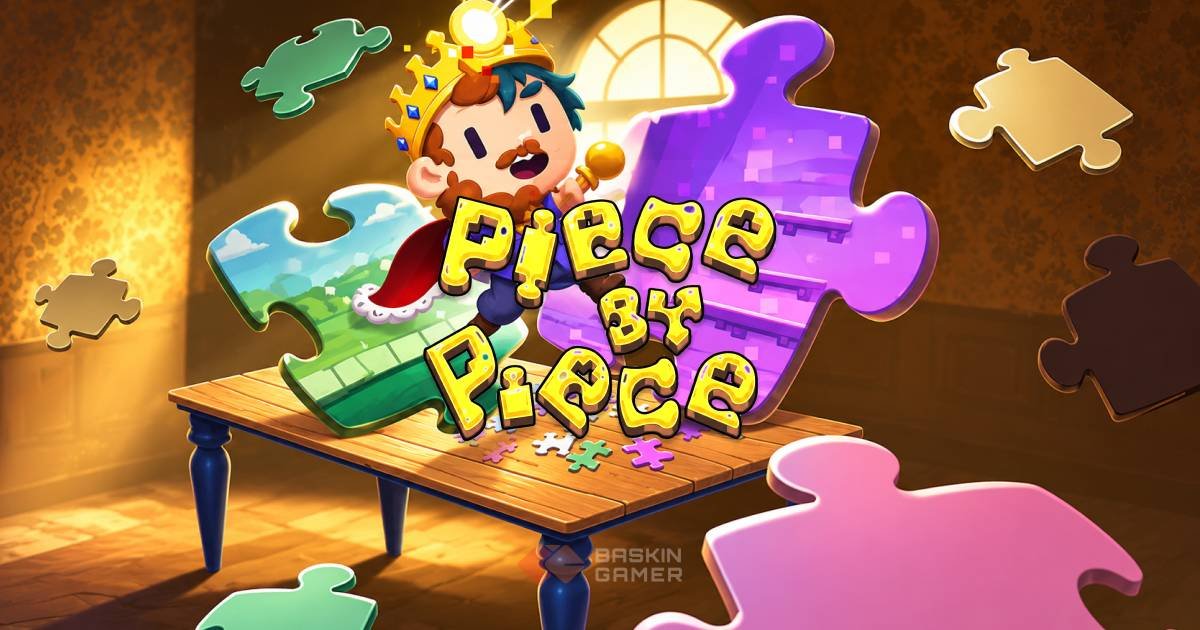
A platforming level usually gives you a path to follow. Piece by Piece by Neon Polygons asks you to build that path yourself. Its world is divided into separate jigsaw-like pieces, and reaching the exit depends on connecting, disconnecting and manipulating those fragments until the environment becomes traversable.
The puzzle-platformer arrives on Nintendo Switch on November 25, 2026, bringing its collection of 100 handcrafted levels to a new console audience. Across 12 puzzle boxes, the game introduces different themes and mechanics, gradually combining them into more demanding challenges. Every level also contains a gold puzzle piece for players who want to complete more than the basic objective.
There is one important detail before starting: another unrelated game called Piece by Piece is launching on Switch on the same day. This guide covers the puzzle-platformer developed by Neon Polygons, not Gamekat’s cosy repair-shop simulation.
Quick Summary
- Developer: Neon Polygons
- Publisher: No More Robots
- Nintendo Switch release: November 25, 2026
- Content: 100 handcrafted puzzles across 12 puzzle boxes
- Main mechanic: Connect and disconnect puzzle pieces to build routes
- Additional mechanics include portals, mining and rotating pieces
- Every level has a gold puzzle piece to collect
- Nintendo lists the game as supported on Nintendo Switch 2, with consistent game behaviour
What Is Piece by Piece by Neon Polygons?
Piece by Piece is a single-player puzzle-platformer that turns the level itself into the main puzzle. Instead of simply navigating a fixed environment, you interact with the pieces that make up the stage.
Platforms, pathways and other parts of the level begin separated. Your task is to understand how they fit together and connect the right fragments to create a route. Once the environment is arranged correctly, your character can move through it and reach the level’s exit.
The idea is easy to understand, but the challenge grows as new mechanics appear. Some stages ask you to solve a straightforward connection problem. Later puzzles require more careful planning because several mechanics can affect the same route.
The game was already released on PC in March 2026. Its November 25 release brings the Neon Polygons puzzle-platformer to Nintendo Switch rather than marking its first-ever launch.
How Connecting and Disconnecting Puzzle Pieces Works
The central mechanic is the ability to connect and disconnect pieces of the level. Think of each stage as a broken platforming route. The pieces contain parts of the environment, but their original arrangement does not necessarily give you a usable path.
You need to examine the available fragments and work out which connections will help you progress.
A useful way to approach this system is to think about the route before making changes:
- Identify your starting position and the exit.
- Look at the pieces between those two points.
- Find fragments that could form a continuous route.
- Connect the relevant pieces and check whether the path works.
- Reconsider the arrangement if a gap or obstacle still blocks progress.
This approach helps prevent random rearranging. A connection might look correct visually but still fail to provide the route you need. Pay attention to how the pieces interact with one another rather than focusing on one fragment in isolation.
Disconnecting pieces is just as important. Sometimes a connection that initially seems useful can restrict another part of the puzzle. Treat the level as something you can reorganise, not a structure that must remain in its first arrangement.
Understanding the 12 Puzzle Boxes
The 100 handcrafted levels are organised into 12 puzzle boxes. Each box introduces a theme and a mechanic that changes how you approach its challenges.
This structure gives the game a clear learning curve. Rather than introducing every system at once, it builds your understanding through themed groups of puzzles.
Early challenges help establish the basic relationship between movement and connected pieces. As you progress, new mechanics create additional ways to interact with the environment. You must then apply what you have learned instead of relying on one familiar solution.
The important thing is to recognise the mechanic a puzzle box is teaching. When a new type of piece appears, spend time understanding its behaviour before trying to solve the entire stage. That knowledge becomes useful when the game starts combining mechanics later.
Portals, Mining and Rotating Pieces
Piece by Piece expands its central connection system with several additional mechanics. Nintendo and the game’s official descriptions highlight the broader progression, while the game’s PC materials identify portals, mining and rotating pieces among the available puzzle elements.
Portals
Portals introduce a different way to think about movement. A route no longer has to depend entirely on connecting platforms in a straight line. You need to consider how the portal mechanic can help link separated areas.
When approaching a portal puzzle, inspect the spaces around the available pieces. Think about where a connection needs to lead and whether the portal offers a more useful route than a conventional platforming path.
Mining
Mining adds another layer to the puzzle environment. Instead of only rearranging pieces, you must account for the ability to interact with certain parts of the stage through this mechanic.
Before making a change, look at what is blocking your progress. Work out whether the obstacle needs a new connection or whether the mining mechanic provides the intended way forward.
Rotating Pieces
Rotation makes orientation part of the solution. A fragment might contain the right platform or route, but its current position may not help you reach the next section.
Consider how turning a piece changes its relationship with nearby fragments. A small adjustment can make a previously unusable connection relevant to the route.
These mechanics encourage different types of thinking. Portals change how you travel, mining changes how you interact with the environment, and rotation changes how you position the available pieces.
How Hybrid Puzzle Levels Combine Mechanics
The later puzzle boxes introduce hybrid challenges. These stages combine themes and mechanics that appeared earlier, testing whether you understand how the individual systems work together.
For example, a puzzle may require you to consider both the arrangement of pieces and a special movement mechanic. Another may make orientation important while also asking you to plan a route through a more complicated layout.
The best way to approach these stages is to separate the problem into smaller questions:
- Which mechanics are present?
- What does each mechanic allow you to do?
- Which part of the route is currently blocked?
- Can one mechanic create an opportunity for another?
- Does changing one piece affect the rest of the route?
Avoid trying to solve every part at once. Identify the immediate obstacle, work out which mechanic addresses it and then consider the next connection.
How to Collect Gold Puzzle Pieces
Every level contains a gold puzzle piece. Reaching the exit is therefore not the only objective if you want to complete the stages fully.
The collectible adds a second layer to each puzzle. A route that gets you to the end may not automatically give you access to the gold piece. You may need to make an additional connection, change the arrangement or explore a section of the level that is not necessary for basic completion.
Use these spoiler-free tips when hunting for collectibles:
- Look beyond the obvious route. Check the surrounding pieces before committing to the exit.
- Study unreachable areas. If the gold piece appears separated from your current path, consider which connection could bring it within reach.
- Revisit the arrangement. A route that works for reaching the exit might not be ideal for collecting everything.
- Pay attention to new mechanics. A collectible may encourage you to use the mechanic introduced in that puzzle box.
- Check the level before finishing. Make sure you have collected the gold piece if you are aiming for a complete run.
Do not assume that the shortest route is always the best route. The extra collectible gives you a reason to examine the entire stage.
Beginner Mistakes to Avoid
The biggest mistake is treating Piece by Piece like a conventional platformer. Movement still matters, but the main challenge is understanding how the environment is assembled.
Keep these common mistakes in mind:
- Randomly connecting pieces: Think about the route first instead of changing everything without a plan.
- Ignoring orientation: Rotating pieces can change whether a connection is useful.
- Forgetting new mechanics: Each puzzle box introduces ideas that may become important later.
- Focusing only on the exit: Every level has a gold puzzle piece, so check for additional routes.
- Rushing hybrid puzzles: Later stages combine mechanics, and solving one part at a time makes the challenge easier to understand.
Taking a moment to inspect a stage can save you from repeatedly changing pieces without making meaningful progress.
Nintendo Switch and Switch 2 Compatibility
Piece by Piece launches on Nintendo Switch on November 25, 2026. Nintendo lists the game as supported on Nintendo Switch 2, with game behaviour consistent with the original Switch version.
The game supports TV, tabletop and handheld modes, giving players different ways to approach its puzzle levels. It is a single-player experience, so the challenges are designed around individual progression.
Players moving to Switch 2 should still check the relevant Nintendo product listing for current compatibility information. Nintendo’s listing currently identifies the game as supported rather than describing a separate Switch 2 edition.
Piece by Piece vs the Other Switch Release
The shared title can easily cause confusion because two unrelated games called Piece by Piece are arriving on Nintendo Switch on November 25.
| Detail | Neon Polygons | Gamekat |
|---|---|---|
| Genre | Puzzle-platformer | Repair-shop simulation |
| Main activity | Rearrange puzzle pieces to build routes | Restore objects for woodland customers |
| Core structure | 100 puzzles across 12 puzzle boxes | Shop management and repair activities |
| Developer | Neon Polygons | Gamekat |
| Publisher | No More Robots | No More Robots |
If you want a platformer built around manipulating fragmented levels, look for the Neon Polygons version. If you want to restore antiques, customise objects and run a cosy shop, that is Gamekat’s separate game.
Final Thoughts
Piece by Piece offers a clever twist on puzzle-platforming by making the level itself something you can manipulate. Its 12 puzzle boxes introduce new mechanics across 100 handcrafted stages, while hybrid challenges ask players to combine what they have learned.
For Nintendo Switch players discovering the game on November 25, the best starting point is to understand the connection system before worrying about perfect completion. Study each new mechanic, plan routes carefully and look beyond the exit when searching for gold puzzle pieces.
The game rewards curiosity and deliberate problem-solving. You are not simply finding a way through the level. You are building that way, piece by piece.
FAQs
How many puzzles are in Piece by Piece?
The Neon Polygons puzzle-platformer contains 100 handcrafted levels organised across 12 puzzle boxes.
What is the main gameplay mechanic?
Players connect and disconnect fragmented puzzle pieces to build routes through each level and reach the exit.
What are the gold puzzle pieces?
Every level contains a gold puzzle piece that players can collect as an additional challenge beyond completing the stage.
Does Piece by Piece have portals and mining?
Yes. Portals, mining and rotating pieces are among the mechanics introduced as players progress through the puzzle boxes.
Is Piece by Piece available on Nintendo Switch 2?
Nintendo lists the game as supported on Nintendo Switch 2, with consistent game behaviour compared with Nintendo Switch.
Is this the same Piece by Piece as the repair-shop game?
No. Neon Polygons developed the puzzle-platformer. Gamekat developed a separate repair-shop simulation with the same title. Both are scheduled to launch on Nintendo Switch on November 25, 2026.
Stay tuned to Baskin Gamer as we bring you the latest updates on game news, releases, and more