
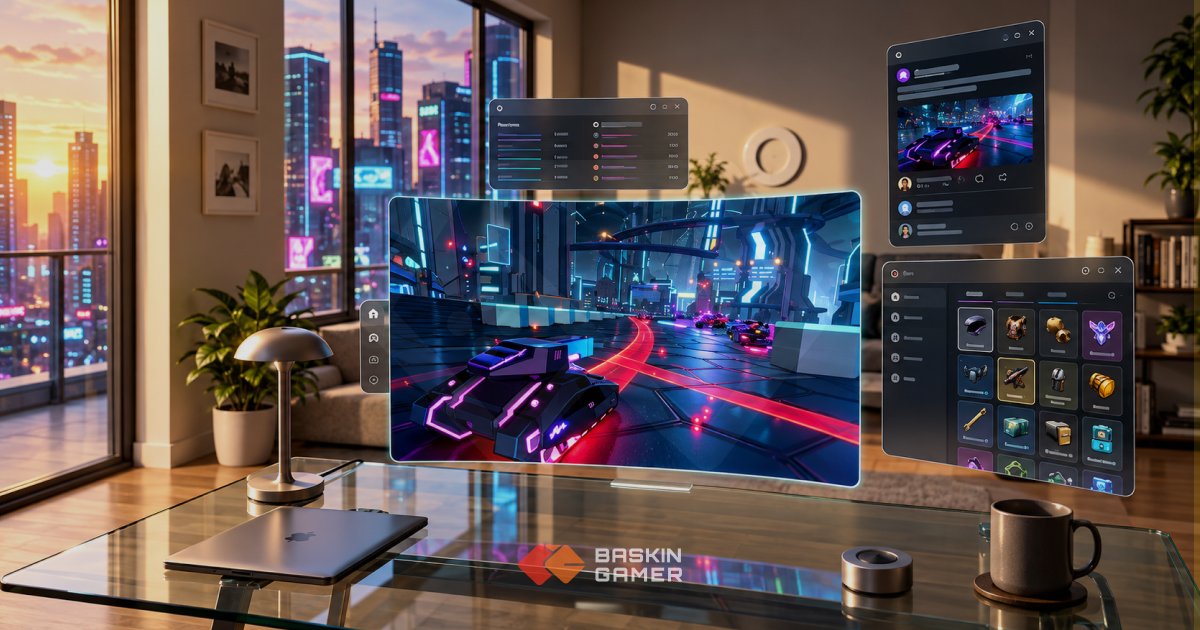
Virtual reality has spent years chasing the same goal: make the experience more immersive without making the hardware harder to wear.
Meta’s new VR Glasses take a different route.
Instead of putting the processor, battery and storage directly inside the device sitting on the player’s face, Meta has moved those components into a separate computing puck connected to the glasses by an optical tether.
The result is a much lighter wearable.
Meta says the glasses themselves weigh about 100 grams. But that number tells only part of the story. The puck, tether and glasses together form the actual gaming system.
That trade-off could end up being more important than the weight figure itself.
Quick Summary
- Meta announced its new VR Glasses on September 23, 2026.
- The glasses are planned for Spring 2027.
- The glasses themselves weigh about 100 grams.
- Computing, battery and storage are handled by a separate puck.
- The puck connects to the glasses through an optical tether.
- Meta says more than 75 games will support hand-gesture controls at launch.
- Xbox Cloud Gaming will provide access to hundreds of additional games through streaming.
- Announced experiences include Tetris Effect: Mixed Realities, Beat Saber: Flux and Phoenix Wright: Ace Attorney – Dual Destinies VR.
- The platform combines hand gestures, eye tracking and other spatial interaction features.
- Real-world comfort, battery endurance and long-session gaming performance cannot be judged until the hardware reaches players.
The Interesting Part Is Not the 100-Gram Weight
The obvious headline is the weight.
About 100 grams is considerably lighter than a conventional standalone VR headset. But the more interesting decision is what Meta had to move away from the user’s face to achieve it.
Traditional standalone VR hardware carries almost everything inside one device.
Display.
Lenses.
Cameras.
Sensors.
Processor.
Memory.
Battery.
All of those components eventually become part of the weight and balance sitting on the player’s head.
Meta is approaching that problem differently.
The glasses handle the wearable experience while the separate puck takes care of computing, battery and storage.
In other words, the face is no longer carrying the entire computer.
That is the real story behind the new design.
Why VR Hardware Has Always Been Difficult to Make Lighter
Making a VR headset lighter sounds simple until you consider what the device has to do.
A modern VR system needs to render two images, track movement, understand the surrounding environment and respond quickly enough to avoid making the experience feel disconnected.
It also needs a display, lenses, cameras and enough processing power to run its software.
Then comes the battery.
Every component has to fit somewhere.
With a traditional standalone headset, much of that hardware ends up around the player’s head. The engineering challenge therefore becomes a balancing act between capability, battery life, cooling and physical comfort.
Meta’s new approach changes the question.
Instead of asking how much technology can fit inside a headset, it asks:
How much technology actually needs to stay inside the wearable part?
That is a much more interesting hardware problem.
The Puck Changes the Trade-Off
The separate computing puck solves one problem while introducing another.
Moving the processor, battery and storage away from the face gives Meta more physical space to work with.
It also reduces the amount of hardware that has to sit around the player’s eyes and forehead.
But the computer has not disappeared.
It has simply moved somewhere else.
The player still needs to carry the puck, and the glasses remain connected to it through an optical tether.
That distinction matters.
A person sitting down to play a slower VR game may barely notice the additional hardware.
Someone standing, moving around or playing a physically demanding experience may have a very different reaction.
The success of this design will therefore depend on how natural the complete system feels, not simply how light the glasses are on their own.
100 Grams Does Not Mean the Entire System Weighs 100 Grams
This is worth making completely clear.
The approximately 100-gram figure refers to the glasses.
The separate puck is not included in that number.
So the more useful question is not whether 100 grams is lighter than a traditional headset.
It is whether carrying a lightweight pair of glasses plus a separate computing unit feels better during an actual gaming session than carrying a heavier all-in-one device.
That cannot be answered from specifications alone.
Comfort depends on balance, fit, heat, cable movement, battery behaviour and how long the player stays inside the experience.
Those are things players will only really understand after spending hours with the hardware.
Hand Tracking Could Be Just as Important as the Hardware
The physical design is only half of Meta’s strategy.
The company is also pushing hand gestures as a major way of interacting with games.
Meta says more than 75 games will support hand-gesture play at launch.
That could matter because traditional VR controllers have always been part of the hardware equation.
Controllers give developers buttons, triggers, analogue sticks and physical feedback.
Hands do not.
A developer working with hand tracking therefore has to rethink how interaction works.
That creates an opportunity for games designed around natural movement rather than traditional controller inputs.
The question is no longer simply:
How do we put this game into VR?
It becomes:
What should this game feel like when the player’s hands are the controller?
That is a much bigger design question.
Beat Saber Shows What Controller-Free VR Could Become
Beat Saber: Flux is one of the clearest examples of this idea.
A rhythm game already depends heavily on physical movement, making it easier to imagine an experience where the player’s hands become the primary input.
That does not mean every VR game can make the same transition.
A complex action game with dozens of controls is a completely different challenge.
But rhythm games, casual experiences, social games and interactive environments could benefit from a simpler interface.
The important point is that hand tracking does not necessarily replace controllers.
It creates another way to design games.
Tetris Effect Points Toward a Different Kind of VR
Tetris Effect: Mixed Realities offers another interesting direction.
Rather than simply placing a traditional game inside a virtual environment, the experience can make greater use of the player’s physical surroundings and hand interaction.
That suggests a broader shift in how developers might think about VR.
The real world does not always have to disappear.
It can become part of the game.
Your room could influence the experience. Your hands could become the interface. Objects around you could provide context.
That kind of design becomes more interesting when the hardware starts looking less like a large headset and more like wearable technology.
Phoenix Wright Shows That Hand Tracking Is Not Only About Action
Phoenix Wright: Ace Attorney – Dual Destinies VR demonstrates another possibility.
The experience uses hand gestures for interactions such as presenting evidence and pointing toward witnesses, alongside voice interaction.
That matters because controller-free VR does not have to mean physically demanding gameplay.
A player could point, gesture, select or manipulate something naturally without needing to remember which button performs the action.
For certain genres, that could make VR interaction feel more intuitive.
The strongest hand-tracking games may ultimately be the ones where players stop thinking about the control system entirely.
Xbox Cloud Gaming Adds Another Layer
Meta’s gaming strategy is not limited to games specifically designed for the new glasses.
Xbox Cloud Gaming will provide access to hundreds of additional games through streaming.
That creates two very different gaming experiences on the same hardware.
One is native VR gaming, where developers build around hand tracking, spatial awareness and the physical characteristics of the glasses.
The other is cloud gaming, where traditional games can be streamed and experienced through the device.
The second approach is easier to understand.
The glasses can effectively become a large personal display for games that were never designed specifically for VR.
The first approach is more important from a long-term hardware perspective.
If developers start creating games specifically around the strengths of this form factor, the platform becomes more than another way to display existing games.
Developers Still Have to Decide Whether the Form Factor Is Worth Supporting
New hardware needs software.
That sounds obvious, but it becomes especially important with a new VR form factor.
Meta has given developers several things to work with: hand tracking, eye tracking, spatial awareness and a lightweight wearable design.
The announced games demonstrate different possibilities.
But developers also have to consider the size of the potential audience and the cost of creating experiences that take advantage of new hardware.
That creates an interesting balance.
If developers can support the new glasses while also reaching players across a wider VR ecosystem, the decision becomes easier.
If a game requires extensive development specifically for one new form factor, the calculation becomes more complicated.
The launch lineup can demonstrate what is possible.
Long-term developer support will show whether those possibilities are actually useful.
Meta Is Not Just Designing a Gaming Device
Gaming is clearly an important part of the platform, but Meta is positioning the glasses as something broader.
The company also describes them as a way to watch movies, experience immersive sports and use virtual workspaces.
That matters for the hardware design.
A gaming headset can be judged primarily by its games.
A broader computing device has a different challenge.
It needs to become useful across several parts of a person’s day.
If the same lightweight wearable can move between gaming, entertainment and productivity, its purpose becomes much broader than traditional VR.
Whether people actually use it that way remains unknown.
The announcement establishes the intended use cases.
Real-world behaviour will determine whether they become habits.
The Biggest Questions Cannot Be Answered Yet
This is where the announcement needs some restraint.
The product is not available yet.
That means several of the most important questions remain unanswered.
How Comfortable Is It After Several Hours?
A lightweight device can still become uncomfortable.
Fit, balance, heat and pressure points all matter.
The 100-gram figure tells us something about the hardware, but not how the complete system feels after a long gaming session.
How Noticeable Is the Tether?
The optical tether is an important part of the design.
It makes the glasses lighter, but the cable becomes part of the player’s physical environment.
Its impact could vary dramatically between seated games and active experiences.
How Long Does the Battery Last During Gaming?
Moving the battery into the puck solves the problem of putting a large battery on the player’s face.
It does not eliminate battery limitations.
Actual gaming endurance will need real-world testing.
How Reliable Is Hand Tracking?
Supporting more than 75 hand-controlled games is a significant launch signal.
It does not tell us how consistently hand tracking will work across different lighting conditions, movements and gameplay situations.
Will Developers Keep Building for It?
A strong launch lineup is useful.
A lasting platform needs continued software support.
That will depend on whether developers find enough value in the hardware’s unique capabilities to keep designing around them.
Could This Change the Direction of VR Hardware?
Possibly.
But the answer should not be decided by the launch announcement alone.
Meta is experimenting with a different physical architecture for VR.
Instead of putting every major component into one headset, it is separating the wearable experience from the computer powering it.
That approach creates obvious compromises.
The user has another device to carry.
There is a tether.
Controllers still matter for some games.
The glasses themselves do not tell us how comfortable the complete system will be.
Yet the underlying idea is significant.
VR does not necessarily have to become better by putting more technology on the player’s head.
It could become better by putting less there.
That is the part of Meta’s design worth watching.
What This Could Mean for Future Gaming Hardware
The most important consequence may not be the glasses themselves.
It could be what other hardware companies learn from the architecture.
If separating computing from the wearable device works well, future VR systems could explore similar designs.
A lightweight display could become the part users actually wear.
Computing could become increasingly modular.
Battery capacity could move away from the head.
Cloud gaming could handle experiences that do not need to run locally.
Hand tracking could become more common as developers learn how to design around it.
None of those ideas is completely new.
What is interesting is seeing them brought together into one gaming platform.
That could influence how designers think about the next generation of VR hardware, regardless of how this particular product performs.
Meta’s Real Challenge Is Making the Whole System Feel Simple
This may ultimately be the hardest part.
The hardware architecture is complicated.
The user experience cannot be.
Players do not want to think about where the processor is located, how the battery is distributed or how the optical connection works.
They want to put on the glasses and play.
If Meta can make the separate puck, tether and hand-tracking system feel almost invisible during normal use, the underlying engineering becomes a strength.
If those components constantly remind the player that they are wearing a computer connected to another computer, the lightweight glasses may not solve the larger comfort problem.
That is why the first real reviews and long-term player experiences will matter so much.
The Real Test Begins in 2027
Meta has shown the concept.
Now the difficult part is proving it.
The hardware still needs to demonstrate how comfortable it is over long sessions. Developers need to show that hand tracking can support meaningful gameplay. The external puck and tether need to disappear into the background rather than becoming obstacles.
Most importantly, players need to decide whether this form factor changes how often they actually want to use VR.
That cannot be established through a specification sheet.
It has to be experienced.
So, Could Meta’s VR Glasses Change Gaming Hardware?
The answer is not clear yet.
What Meta has done is more interesting than simply making another VR headset.
It has questioned where the computer needs to be.
The glasses carry less hardware. The puck carries the rest. Developers get new possibilities through hand tracking and spatial interaction, while cloud gaming provides a path for traditional games.
There are still plenty of unanswered questions.
Comfort has not been proven.
Long-session battery performance has not been established.
The tether has not been tested by ordinary players at scale.
Developer support beyond the launch lineup remains unknown.
None of that makes the concept less interesting.
It makes the eventual real-world testing more important.
The biggest idea behind Meta’s new VR Glasses may be simple: the future of VR could depend less on making the headset carry more and more on finding ways to make the player carry less.
If that approach works, gaming hardware could start moving toward a very different shape.
Not necessarily a smaller headset.
Something closer to glasses, connected to a computer that no longer needs to sit on your face.
FAQ
What are Meta VR Glasses?
Meta VR Glasses are a new VR platform announced by Meta in September 2026. The glasses use a lightweight wearable design while computing, battery and storage are handled by a separate connected puck.
How much do Meta VR Glasses weigh?
The glasses themselves weigh about 100 grams. The separate computing puck is not included in that figure.
When will Meta VR Glasses launch?
Meta has announced a Spring 2027 launch window.
Do Meta VR Glasses require controllers?
Not for every experience. Meta says more than 75 games will support hand-gesture controls at launch, while traditional controllers remain relevant for games that require them.
Can you play Xbox games on Meta VR Glasses?
Xbox Cloud Gaming will provide access to hundreds of games through cloud streaming.
What games are coming to Meta VR Glasses?
Announced games include Tetris Effect: Mixed Realities, Beat Saber: Flux and Phoenix Wright: Ace Attorney – Dual Destinies VR, alongside other experiences planned for the platform.
Are Meta VR Glasses replacing traditional VR headsets?
That has not been established. The glasses represent a different VR hardware approach, but their long-term position in the market will become clearer after launch and real-world testing.
Is the 100-gram figure the weight of the entire system?
No. The approximately 100-gram figure refers to the glasses themselves. Computing, battery and storage are handled by a separate puck connected to the glasses.
Why does Meta use a separate computing puck?
Moving computing, battery and storage away from the glasses allows the wearable portion to remain significantly lighter and reduces the amount of hardware that needs to sit on the player’s face.
Final Thoughts
The most interesting thing about Meta’s VR Glasses is not simply that they are lighter.
It is why they are lighter.
Meta has moved some of the hardware away from the player’s face and accepted a different set of compromises in return.
There is a separate computing device.
There is a tether.
Hand tracking has to prove that it can support more than demonstrations.
Developers have to decide whether the new form factor gives them enough opportunities to rethink their games.
And players will ultimately decide whether the complete system feels more natural than the VR hardware they already know.
That is why this announcement is worth watching from a gaming perspective.
The future of VR may not be about putting a more powerful computer on your head.
It may be about finding a better way to keep the computer off your head entirely.
Stay tuned to Baskin Gamer as we bring you the latest updates on game news, releases, and more