
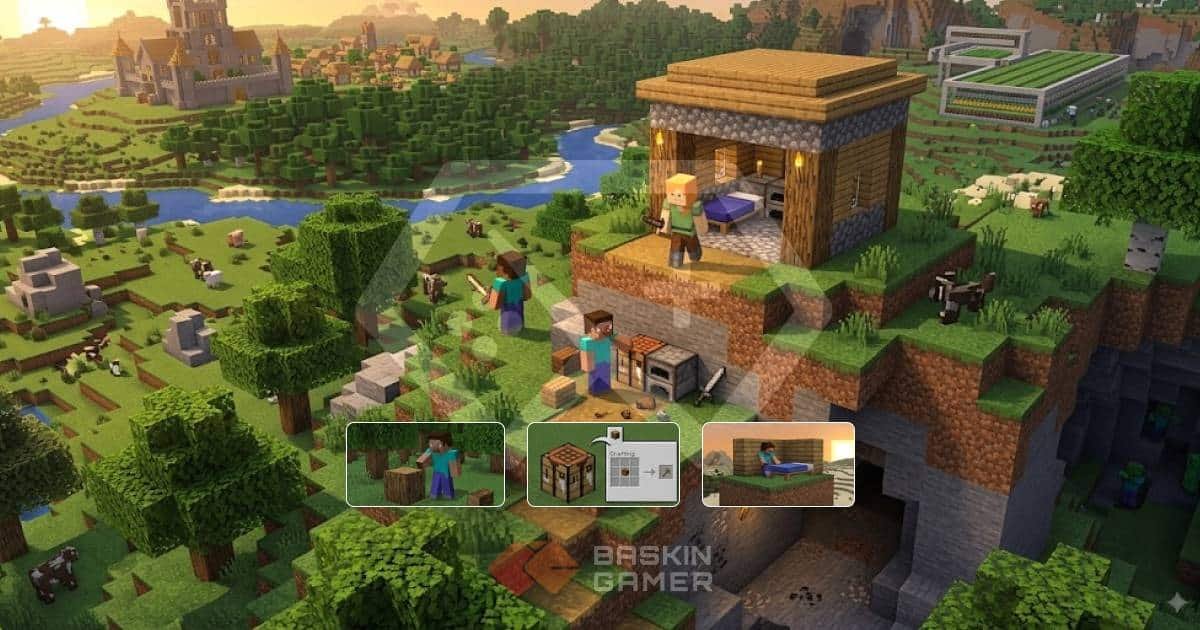
You spawn in.
There are trees nearby. A few animals are wandering around. You have nothing in your inventory, the sun is already moving across the sky, and somewhere in the distance you can hear something that probably isn’t friendly.
Welcome to Minecraft.
The funny thing about starting Minecraft is that the game doesn’t really stop to explain itself. It gives you a world and expects you to figure out what you want from it.
That can be confusing at first.
It also happens to be one of the best things about the game.
You don’t need to know every crafting recipe, every biome, or every enemy before you start. You just need to understand the basics. Once those pieces fall into place, the rest starts making sense.
What Are You Actually Supposed to Do in Minecraft?
This is probably the first question a new player asks.
The honest answer?
Whatever you want.
Minecraft doesn’t have one objective that every player must follow. You can treat Survival as an adventure and work your way toward the Ender Dragon. You can build houses and villages. You can spend hours underground looking for resources. You can farm, explore, trade, experiment with redstone, or play with friends.
There is progression, but there isn’t a strict checklist hanging over your head.
That’s why one player’s Minecraft world can look completely different from another’s.
And there is no wrong answer.
Survival or Creative?
If you’re creating your first world, you’ll probably notice the two main modes.
Survival gives you the classic Minecraft experience. You gather resources yourself, craft equipment, manage health and hunger, deal with hostile mobs, and gradually make your world safer and more developed.
Creative removes most of those restrictions. You have access to building materials, can fly, and don’t have to spend hours mining for the blocks you want.
Creative is fantastic if you simply want to build.
For a completely new player, though, I’d start with Survival.
Not because it’s the “correct” way to play.
It isn’t.
Survival simply teaches you why the different parts of Minecraft exist. After a few nights of worrying about food and shelter, you’ll understand why a farm matters. After running out of coal, you’ll understand why torches matter. After getting lost underground, you’ll probably become very interested in keeping your coordinates or marking your route.
Minecraft teaches through consequences.
Sometimes those lessons hurt.
Your First Few Minutes Are More Important Than They Look
Don’t worry about building a giant house.
You don’t need one.
Start with wood.
Find a tree and collect some logs. Turn those logs into planks, make a crafting table, and create basic tools. From there, stone becomes your next useful step.
It sounds almost too simple.
That’s because it is.
Minecraft’s early game is built around a chain of small improvements. Wood gives you basic tools. Those tools help you collect stone. Stone tools make gathering resources easier. Better resources lead to better equipment.
You keep moving forward without needing a quest marker to tell you what comes next.
Your First Night Is the Real Introduction
Daytime Minecraft can feel peaceful.
Then the sun disappears.
Hostile mobs begin appearing in dark areas, and suddenly that beautiful landscape doesn’t feel quite as welcoming.
Don’t make your first night complicated.
Find somewhere safe.
It can be a tiny wooden room. It can be a shelter dug into a hillside. It can even be an ugly little box that you promise to replace later.
Nobody is judging your first house.
The important thing is having a protected place where you can survive the night.
Once you have the materials, a bed makes life much easier. Sleeping lets you skip the night and also establishes a new respawn point. Torches are equally useful because light helps keep dark areas around your base safer.
That tiny shelter will probably look terrible.
Keep it anyway.
It is where your world starts becoming yours.
Learn Crafting Without Memorizing Everything
Minecraft has a huge number of recipes.
Don’t try to memorize them.
The recipe book exists for a reason. Use it.
The basic idea is straightforward: collect materials, place them in the appropriate crafting grid, and turn them into something more useful.
A few items are worth learning early because you’ll use them constantly:
- Crafting table
- Pickaxe
- Axe
- Furnace
- Chest
- Torches
- Bed
- Basic weapons
- Basic armor
After that, let the game teach you.
You’ll eventually see an item and wonder, “What can I do with this?”
That’s a much better way to learn Minecraft than trying to memorize a giant list before you’ve even finished your first house.
Food Is Your Quiet Problem
Hunger doesn’t feel important when you first spawn.
Then you start running everywhere.
You jump over hills. You sprint through forests. You mine. You fight. You explore.
Suddenly your food bar is disappearing.
Keep food with you.
Early on, you can gather food from animals, crops, villages, and other sources you encounter. Once you’ve settled somewhere, creating a small farm is worth the effort. It gives you a renewable source of food and removes one annoying problem from longer trips.
Don’t wait until you’re starving to think about food.
That usually happens at the worst possible moment.
Mining Is Where the Game Starts Opening Up
At some point, basic stone equipment won’t be enough.
You’ll want iron.
Then better armor.
Then stronger tools.
Then you’ll start wondering where the rarer resources are hiding.
That’s when mining becomes a much bigger part of the game.
Caves can be exciting because you can find useful resources quickly, but they can also turn dangerous without warning. Bring torches. Carry food. Keep spare tools. Don’t fill every inventory slot before you’ve even started exploring.
And please don’t dig straight down.
It sounds like an old Minecraft joke because it is one of those lessons that players keep learning the hard way.
You don’t know what is underneath you.
Maybe it’s another cave.
Maybe it’s lava.
Maybe it’s a very long fall.
There are safer ways to dig.
Use them.
What Should You Keep in Your Inventory?
This becomes more important as your world grows.
A beginner’s inventory tends to become a random collection of everything they’ve touched.
Dirt.
Seeds.
Three different types of flowers.
A nearly broken wooden pickaxe.
Some blocks they don’t remember collecting.
One useful item buried somewhere underneath all of it.
Try to keep things organized.
Carry your main tools, food, torches, and whatever equipment you need for the trip you’re taking. Store valuable resources back at your base before going somewhere risky.
Chests aren’t exciting.
They are still your best friend.
A little organization now can save you from a lot of frustration later.
Your First Base Doesn’t Need to Be Your Forever Base
This is another trap beginners fall into.
They find a location and immediately start building their dream mansion.
Then they discover a village they like more.
Or a better landscape.
Or a huge cave underneath their house.
Or a mountain that would have been perfect for the base.
Don’t worry about it.
Your first shelter is allowed to be temporary.
Build where it’s convenient. Keep your storage and crafting equipment together. Put a small farm nearby. Learn the surrounding area.
After you’ve played for a while, you’ll know what you actually want from a permanent base.
That’s when the giant castle can begin.
Exploration Is Half the Fun
Minecraft becomes much bigger once you stop thinking only about survival.
Go somewhere.
See what’s there.
You might find a village. You might discover a new biome. You might stumble across a structure you weren’t expecting.
Sometimes you’ll find something amazing.
Sometimes you’ll walk for ages and come home with nothing but a few blocks you could have collected five minutes from your base.
That’s fine.
Exploration isn’t always efficient.
It doesn’t need to be.
A game this open can afford to waste a little time.
What About the Nether and the End?
Eventually, you’ll hear players talking about two places: the Nether and the End.
Both are important parts of Minecraft’s progression, but neither needs to be on your first-day checklist.
The Nether is dangerous and introduces its own environments, resources, and creatures. The End takes you toward one of Minecraft’s biggest challenges: the Ender Dragon.
You can work toward those goals when you’re ready.
Before that, get comfortable in the Overworld.
Learn how combat feels.
Build a reliable food supply.
Understand mining.
Get decent equipment.
Make your base useful.
Once those things feel normal, the next stage of Minecraft won’t seem nearly as intimidating.
Playing With Friends Changes the Entire Game
Minecraft with friends is almost a different experience.
One person might go mining.
Someone else starts building.
Another player decides the group desperately needs a farm.
Nobody asked them to build the farm.
They’re doing it anyway.
That’s part of the fun.
A shared world creates its own stories. You might build a road between two bases, turn a village into a proper settlement, explore together, or spend an entire evening working on something that wasn’t even planned when you started playing.
Minecraft’s multiplayer experience also depends on the edition you’re using, so check compatibility before setting up a world with friends.
Java or Bedrock?
New players often get confused by this.
The short version is that Java Edition and Bedrock Edition are different versions of Minecraft with different strengths and multiplayer ecosystems.
If you’re playing on PC, Java may be the version you’re most interested in, particularly if you’re curious about the long-established Java modding and server communities.
Bedrock is designed for broader cross-platform play across supported devices.
If your friends are already playing Minecraft, ask which edition they’re using before you buy or set up a multiplayer world.
That one question can save you a surprisingly annoying conversation later.
Don’t Try to Learn Minecraft From Someone Else’s World
This might be the most important advice in the whole guide.
You will see incredible Minecraft builds online.
Massive castles.
Underground cities.
Automatic farms.
Redstone machines that look like they belong in an engineering textbook.
It’s easy to look at all that and think you’re playing the game badly.
You’re not.
Someone else’s tenth year of Minecraft doesn’t need to become your first week’s target.
Build the ugly house.
Make the tiny farm.
Get lost.
Learn how to find your way home.
Then improve.
That’s how Minecraft becomes your game rather than a checklist of things you think you should already know.
Beginner Mistakes You Can Avoid
A few mistakes are almost universal.
Don’t carry everything valuable with you. Store important resources before risky trips.
Don’t ignore food. Hunger can turn a safe journey into a desperate walk home.
Don’t dig straight down. There are safer ways to mine.
Don’t rush into caves without preparation. Torches, food, tools, and spare space matter.
Don’t fight everything you see. Running away is a perfectly good strategy.
Don’t spend your first hours chasing diamonds. A reliable base and decent iron equipment can make the rest of the game much easier.
And don’t worry if you die.
You probably will.
Most players have a story about losing something important in Minecraft. Consider it part of the education.
What Should You Do After You Understand the Basics?
This is where Minecraft gets interesting.
There isn’t another chapter waiting for you.
You decide what comes next.
Maybe it’s a proper house.
Maybe it’s a farm.
Maybe you want to explore every biome you can find.
Maybe you’re interested in enchanting.
Maybe you want to learn redstone.
Maybe you’re ready to start preparing for the Nether.
Or perhaps you’ve discovered that you really just enjoy building bridges.
Go build bridges.
Minecraft’s progression is useful, but it isn’t the reason the game has lasted this long.
The freedom is.
Why Minecraft Still Works for New Players
Minecraft has changed enormously since its early days, and it continues to receive new content through regular game drops. That evolution matters, but the basic loop remains recognizable: gather something, make something, discover something, then decide what to do next.
That simplicity gives the game an unusual advantage.
A new player doesn’t have to understand Minecraft’s entire history.
You can start today.
Punch a tree.
Build a shelter.
Survive the night.
Then tomorrow, do something you couldn’t do today.
That’s enough.
FAQ
What should I do first in Minecraft?
Collect wood, make basic tools, gather food, and find a safe place before the first night. Once you’re secure, start collecting stone and iron and establish a simple base.
Is Survival better than Creative for beginners?
Survival is useful for learning how Minecraft’s systems connect. Creative is better if your main goal is building and experimenting. There is no wrong choice.
What should I build first?
Start with a practical shelter containing storage, crafting space, a furnace, and a bed. Make it larger or prettier later when you’ve learned more about the area.
What should I take when exploring?
Food, tools, torches, and enough inventory space for whatever you find. If you’re heading somewhere dangerous, avoid carrying everything valuable from your base.
What happens when I die?
You respawn according to your current spawn point, but items dropped at the location of your death can be lost if you don’t recover them in time. That’s why storing valuable items before a dangerous trip is such a useful habit.
Do I need to defeat the Ender Dragon?
No. The Ender Dragon is a major progression goal, but Minecraft doesn’t require you to defeat it before you can enjoy the rest of the game.
Can I play Minecraft with friends?
Yes. Minecraft supports multiplayer and cross-platform play in supported configurations. Bedrock Edition supports cross-platform play across supported devices.
Final Take
Minecraft doesn’t really have a tutorial.
It has a world.
That’s why the first few hours can feel strange. The game isn’t constantly telling you what to do. It gives you enough tools to survive and then waits to see what you decide to make of them.
So don’t worry about learning everything.
Learn the first tree.
Then the first tool.
Then the first shelter.
Then the first cave.
After that, Minecraft starts teaching you on its own.
And somewhere along the way, that little box you built because night was coming starts becoming a home.
That’s when you know you’ve stopped learning Minecraft and started playing it.
Stay tuned to Baskin Gamer as we bring you the latest updates on game news, releases, and more